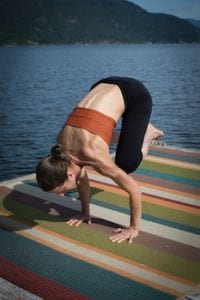
Crow Pose, or Bakasana, is a challenging arm balance that combines upper-body strength, core control, wrist tolerance, balance and coordination. It can also be a satisfying way to practice patience because progress usually happens gradually rather than all at once.
You do not need to “float effortlessly” for the pose to be worthwhile. The real value is in learning how to organize your body, shift your weight and build confidence step by step.
What Crow Pose Can Help You Develop
Crow can challenge:
- wrist and shoulder strength
- core engagement
- balance
- coordination
- body awareness
- confidence with weight-bearing through the hands
The mental focus required for an arm balance can also make the practice feel absorbing and meditative, but I would avoid presenting Crow as a treatment for stress or anxiety.
Start With the Shape on Your Back
Before loading the wrists, practice the basic shape lying down.
Lie on your back with the knees drawn toward the chest. Bring the knees toward the upper arms, round the upper back slightly and engage the abdomen.
Try:
- holding the shape for 20–30 seconds
- flexing the wrists as if the palms were pressing into the floor
- reaching the toes forward
- bringing one knee at a time toward the centre
- practicing a hollow-body position
This lets you understand the shape without worrying about balance.
Warm Up the Wrists
Crow puts a lot of load through the hands and wrists, so spend a few minutes preparing them.
From hands and knees, explore:
- fingers pointing forward and gentle rocking
- fingers turned slightly outward and side-to-side movement
- fingers turned toward the knees with a small backward shift
- very gentle loading on the backs of the hands if comfortable
- Cat-Cow with attention to shoulder-blade movement
Keep the range small. Wrist preparation should not hurt.
Build Shoulder and Core Control
From hands and knees, bring one knee toward the same-side upper arm.
Lower it, then repeat.
You can also hover the knee slightly off the floor for a few seconds.
Add a few controlled transitions between Plank and Downward-Facing Dog to prepare the shoulders and trunk.
Warm Up With Sun Salutations
Move through 2–3 comfortable Sun Salutations.
Use this section to warm the whole body rather than rushing.
You might include:
- Downward-Facing Dog
- Plank
- Cobra
- Low Lunge
- Warrior I
- Pyramid Pose
Keep breathing steady.
Malasana to Crow Preparation
Come into a Low Squat, or Malasana.
Place the hands on the floor about shoulder-width apart and begin shifting your weight forward.
Keep the toes down at first.
Bring the knees toward the upper arms and practice feeling more weight in the hands without trying to lift both feet.
Use Blocks for Confidence
Blocks can make Crow less intimidating.
One option is to stand on a block so the hips begin higher.
Another is to place a block or bolster in front of the head so you feel less afraid of tipping forward.
The goal is not to rest the head heavily on the block. It is there as reassurance while you learn the weight shift.
Half Crow Progression
From Downward-Facing Dog, lift one leg.
Move forward toward Plank and bring the knee toward the outside of the upper arm.
Repeat 2–3 times.
This builds some of the hip, core and shoulder coordination used in Crow without requiring the full balance.
Practice the Weight Shift
From Malasana:
- Place the hands firmly on the mat.
- Bend the elbows slightly.
- Bring the knees high onto the upper arms.
- Look a little forward rather than straight down.
- Shift the chest forward.
- Lift one foot.
- Put it down and try the other side.
- If that feels controlled, experiment with lifting both.
The forward shift is essential. If your weight stays behind your hands, the feet will not become light.
Crow Pose
Once both feet lift, bring the feet toward each other and keep the upper back engaged.
You do not need to straighten the arms immediately. A bent-arm Crow is a perfectly valid place to practice.
Hold for one or two breaths at first, then gradually increase the time.
Come down before form breaks down.
Chair to Crow Transition
For a more advanced progression, begin in Chair Pose.
Lower toward a squat, place the hands down and transition into Crow.
This requires more coordination and should come after you are already comfortable entering Crow from Malasana.
Lolasana and Core Work
Lolasana preparation can help develop compression strength.
Sit cross-legged, place the hands beside the hips and press firmly into the floor or blocks.
Try to lift the knees toward the chest, even if the feet do not leave the ground.
You can also include:
- Boat Pose
- Half Boat or Hollow Body
- toe-reach variations
- seated compression work
These movements support the ability to draw the legs toward the torso.
Counterbalance With Backbends and Chest Opening
After a lot of forward rounding and arm loading, include some comfortable opening movements.
Try:
- Cobra
- Bow Pose if appropriate
- gentle chest and shoulder stretches
- Supported Bridge
- Supine Twist
Keep backbends distributed through the whole spine rather than forcing the lower back.
Finish With Rest
End with Savasana or another comfortable resting position.
Arm balances can be mentally demanding, so give yourself a few minutes to let the nervous system settle after the effort.
Progress Takes Repetition
Crow is often more about coordination and confidence than brute strength.
Some days it may feel easy. Other days it may not.
That is normal.
You can practice the pieces separately: wrist preparation, shoulder strength, core compression, squatting, weight shifting and balance.
If you want individualized help with strength, mobility and movement progressions, learn more about Personal Training in Nanaimo or explore Yoga & Mobility Classes in Nanaimo.