Become a Circus Arts Leader: Learn, Play and Teach With Confidence
Circus arts can be a fun way to build coordination, creativity, confidence and connection. They can also give teachers, educators, recreation leaders and group facilitators a completely different set of tools for getting people moving.
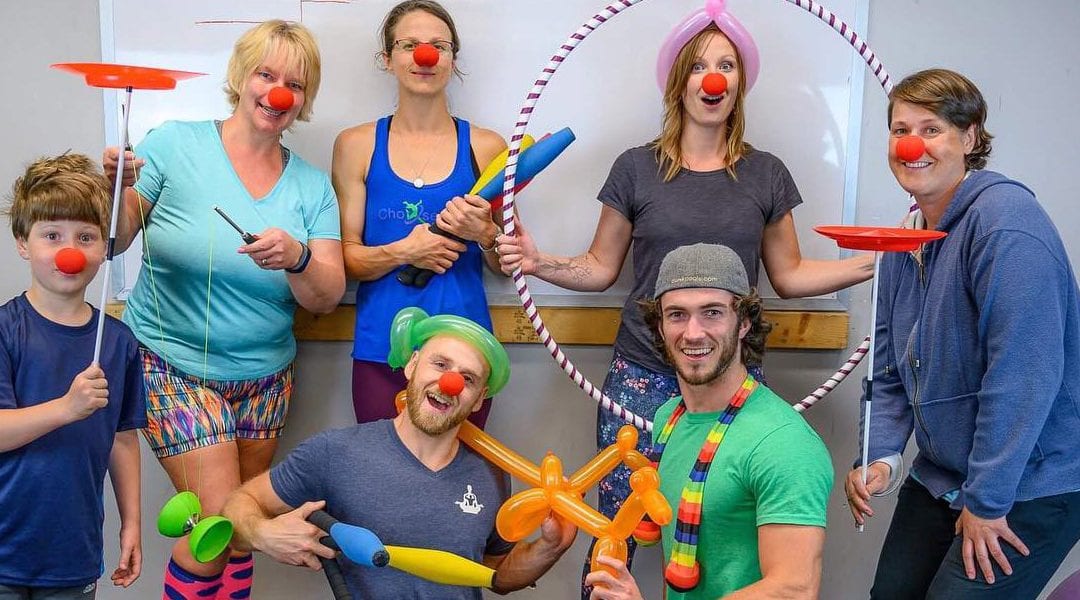
My Circus Arts Leader Certification is an online course designed to help you learn beginner-friendly circus skills and turn them into games, activities and lesson ideas you can use with children or adults.
Who Is This Course For?
This course may be a good fit if you are a:
- teacher
- education assistant
- recreation leader
- camp leader
- fitness or movement instructor
- youth worker
- parent or homeschool educator
- anyone who enjoys playful movement and wants new group activities
You do not need a circus background.
The goal is not to become a professional performer. It is to learn approachable skills you can teach safely and confidently.
Why Circus Arts?
Circus arts naturally combine movement, problem-solving and creativity.
They can help people practice:
- hand-eye coordination
- balance
- rhythm
- persistence
- concentration
- teamwork
- creative expression
- confidence trying something unfamiliar
They are also easy to adapt.
One participant may be learning to toss one scarf while another is working on three-ball juggling. Both can be challenged at an appropriate level.
Cooperation Over Competition
One of the things I love most about circus arts is that they do not need to be competitive.
People can learn side by side, celebrate each other’s progress and help each other experiment.
That makes circus activities useful in schools, camps and community programs where the goal is participation rather than winning.
What You Learn in the Circus Arts Leader Course
The course focuses mainly on object manipulation, balance, games, creativity and introductory leadership skills.
You will explore activities such as:
- scarf and ball juggling
- juggling rings and clubs
- poi spinning
- hula hooping
- flower sticks
- diabolo
- plate spinning
- balance activities
- cooperative games
- clowning and character play
- improvisation and storytelling
You will also get ideas for structuring sessions and adapting activities for different groups.
Juggling and Object Manipulation
Object manipulation is a major part of the course.
Juggling does not have to start with three balls flying through the air.
Scarves are one of my favourite teaching tools because they move slowly and give beginners time to track the object and understand the basic pattern.
From there, people can gradually progress to balls, rings or other props.
Poi, hula hoops, flower sticks, diabolo and spinning plates create completely different movement challenges and give participants many ways to find something they enjoy.
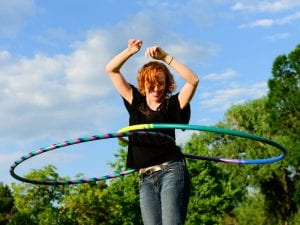
Hula Hooping
Hula hooping can involve much more than keeping a hoop around the waist.
Hoops can be rolled, balanced, passed, spun on the hands and incorporated into games.
That makes them an accessible prop for group activities even when someone has never learned traditional waist hooping.
Poi Spinning
Poi spinning uses controlled circular patterns around the body.
Beginners can start with simple forward and backward circles before exploring direction changes and more complicated patterns.
The focus is coordination and learning the pathways gradually, not rushing toward tricks.
Diabolo and Spinning Plates
Diabolo and plate spinning are great examples of activities where persistence becomes part of the fun.
At first, the goal may simply be keeping the object moving for a few seconds.
Small improvements are very noticeable, which can make these activities particularly satisfying for beginners.
Balance Skills
Balance activities may include balance boards, walking challenges and introductory equipment-based skills.
More advanced equipment such as unicycles requires additional skill, space and appropriate safety considerations.
The goal of the leader course is to give you a broad toolkit, not to make you an expert in every circus discipline.
Theatre, Clowning and Character Play
Circus is not only about physical skills.
Role-playing, improvisation, storytelling and character development can make a circus session much more creative.
Sometimes I use superhero characters instead of traditional clowning, especially with groups that may not connect with clowns.
The purpose is simply to give participants permission to play.
What This Course Does Not Teach
Some circus disciplines require specialized facilities, equipment and instruction.
Acrobatics
Formal gymnastics and advanced acrobatics are best learned in environments designed for them, with appropriate coaching and safety equipment.
Aerial Arts
Trapeze, silks, aerial hoop and other aerial disciplines require professional rigging and specialized instruction.
They are not part of this course.
Fire Performance
Fire juggling and fire spinning require specialized equipment, training, site precautions and safety procedures.
Fire performance is not taught or encouraged as part of the Circus Arts Leader Certification.
Dance Training
Movement and dance may appear in games and creative activities, but this is not a dance-teacher certification.
You Do Not Need to Master Everything
One of the most important things I tell participants is that you do not have to become highly skilled at every prop.
You may love hooping and never become interested in diabolo.
You might enjoy juggling but prefer not to teach balance work.
That is completely fine.
The course gives you enough exposure to discover what works for you and the groups you lead.
Teaching Through Progressions
Circus skills become much easier when they are broken down.
Instead of saying, “Here are three balls—juggle,” you can teach:
one scarf → two scarves → throwing patterns → one ball → two balls → three-ball progressions.
That approach gives participants repeated opportunities to succeed.
It also helps leaders create activities for mixed-ability groups.
Circus Arts and Physical Literacy
Circus activities can expose people to many different movement skills without making the experience feel like a conventional workout.
Throwing, catching, balancing, rotating, stepping, reaching and coordinating both sides of the body all appear naturally through play.
That variety can make circus arts a useful addition to physical-education, recreation and movement programs.
What About the Brain?
Circus skills require attention, visual tracking, timing and coordination.
Learning a new skill challenges the brain because the task is unfamiliar and requires repeated practice.
I would avoid the old claim that circus “activates both sides of the brain,” because the brain does not work in such a simple left-brain/right-brain way.
A better way to describe it is that activities such as juggling require several systems to work together: vision, attention, timing, movement planning and coordination.
Juggling and Eye Tracking
Juggling also creates an interesting visual challenge.
Your eyes repeatedly track objects moving through space rather than staying fixed on a screen or stationary target.
That makes juggling a fascinating coordination exercise.
I would not present it as therapy for visual, neurological or psychological conditions unless that is being done by an appropriately qualified healthcare professional.
Play Can Be Valuable on Its Own
Not every activity needs to be justified by a dramatic health claim.
Sometimes the benefit is simply that people are moving, laughing, experimenting and learning something new.
Those experiences can be valuable in schools, camps, fitness programs and community settings.
Create Your Own Circus Arts Program
The purpose of the course is to leave you with practical material you can actually use.
You will learn skills, games and activity ideas that can be combined into your own sessions.
You can adapt them depending on:
- age
- group size
- available equipment
- experience level
- indoor or outdoor space
- amount of time available
Over time, your own teaching personality becomes part of the program.
Ready to Learn?
You do not need to be a circus performer to introduce circus arts to a group.
You need a few foundational skills, good progressions, appropriate equipment and a willingness to play.
Learn more about the online Circus Arts Leader Certification or explore my broader Circus Arts programs and experience.