The Core 4: Diaphragm, Pelvic Floor, Transverse Abdominis and Multifidus
The core is much more than the visible abdominal muscles.
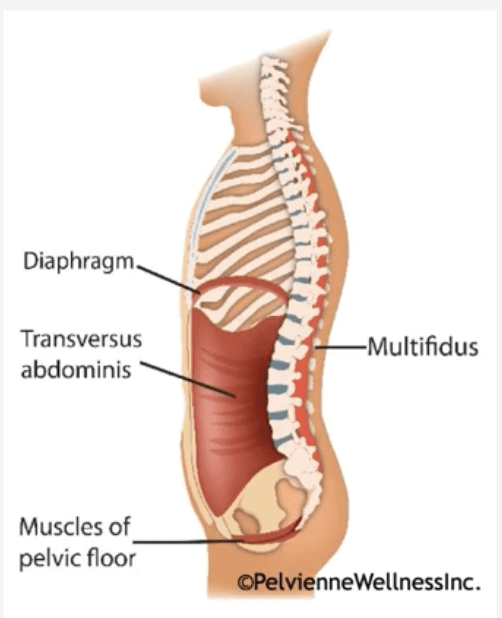
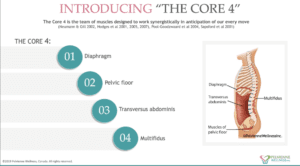
Four important components often discussed together are the diaphragm, pelvic floor, transverse abdominis and multifidus. These structures work together during breathing, lifting, balance and everyday movement.
The idea is useful, but the body is more complex than a four-muscle system, and these muscles do not always contract in one fixed sequence.
The Diaphragm
The diaphragm is the primary muscle of breathing.
When you inhale, it descends and the rib cage expands.
That movement influences pressure inside the abdomen and coordinates with the abdominal wall and pelvic floor.
The diaphragm also interacts with surrounding tissues, including structures near the lumbar spine and psoas, but I would avoid turning that anatomical relationship into claims that one muscle directly “controls” another.
The Pelvic Floor
The pelvic floor is a group of muscles at the base of the pelvis.
It contributes to:
- bladder and bowel control
- support of the pelvic organs
- sexual function
- pressure management
- coordination with breathing and movement
A healthy pelvic floor needs more than strength.
It also needs timing, endurance, coordination and the ability to relax.
You can read Pelvic Floor Health: Why Strengthening Isn’t Always the Answer for more.
The Transverse Abdominis
The transverse abdominis, or TVA, is one of the deeper abdominal muscles.
It wraps around the torso and contributes to trunk control and pressure management.
It is sometimes called an “internal corset,” but that analogy can be misleading if it makes people think the abdomen should stay pulled in all day.
The TVA is one part of a larger core system.
The Multifidus
The multifidus muscles run along the spine.
They help control movement between the vertebrae and contribute to spinal stability.
They work together with many other back and trunk muscles rather than acting as a single spinal “stabilizer switch.”
How the Core 4 Works Together
These muscles coordinate rather than functioning independently.
During breathing, for example, the diaphragm moves, the pelvic floor responds, and the abdominal wall changes tension.
During lifting or exercise, that coordination may become firmer to help manage pressure and create trunk stability.
The exact pattern depends on the task.
There is no single universal rule such as:
inhale = pelvic floor lifts and TVA contracts
The coordination is more dynamic than that.
Inhale and Exhale
A relaxed inhale generally allows the diaphragm to descend and the pelvic floor to lengthen slightly.
During exhalation, the diaphragm rises and the pelvic floor may recoil upward.
During harder effort, however, the pattern can change depending on load, breathing strategy and the person.
That is why rigid breathing cues do not work for everyone.
Core Stability Is Not the Same as Constant Tightness
A strong core does not mean holding your stomach in all day.
Good core function means being able to create enough tension when needed and then relax afterward.
That applies to:
- lifting
- carrying
- running
- balance
- yoga
- hiking
- everyday tasks
Pelvic Floor Dysfunction
Pelvic-floor dysfunction can involve weakness, excessive tension, poor coordination or a combination of these.
Symptoms may include:
- urinary leakage
- bowel symptoms
- pelvic heaviness or pressure
- pelvic pain
- pain with intercourse
- difficulty relaxing
- difficulty with bladder or bowel emptying
Low back pain and pelvic-floor dysfunction can sometimes occur together, but I would remove the claim that 95% of women with low back pain have pelvic-floor dysfunction unless you have a very strong, specific source for that exact population and statistic.
That number is too strong to use as a general fact.
Pelvic Floor Risk Factors
Some factors are associated with pelvic-floor problems, including:
- pregnancy and childbirth
- aging
- chronic coughing
- constipation
- some surgeries
- connective-tissue differences
- repetitive high-pressure tasks
- certain neurological or medical conditions
I would remove BMI under 25 from the list.
That does not belong there as a general risk factor.
I would also avoid presenting posture or heavy lifting as simple direct causes.
Does Heavy Lifting Damage the Pelvic Floor?
Not automatically.
Heavy lifting increases pressure demands, but many people can lift safely with good technique, appropriate progression and proper pressure management.
The problem is not that lifting itself is bad.
The question is whether the load matches the person’s capacity and whether symptoms such as leaking, heaviness or pain are appearing.
Core Training Should Be Broader Than Isolation
You do not need to isolate each Core 4 muscle in every workout.
A balanced program might include:
- dead bugs
- bird dogs
- carries
- side planks
- squats
- deadlifts
- Pallof presses
- bridges
- breathing drills
- mobility work
These exercises challenge the core as a coordinated system.
What About Kegels?
Kegels can be useful when pelvic-floor weakness is part of the problem.
But they are not right for everyone.
If the muscles are already overactive or difficult to relax, more squeezing may make symptoms worse.
That is why assessment matters.
What About TVA “Activation”?
It can be helpful to learn how the lower abdomen feels when the TVA engages.
But you do not need to consciously “turn on” the TVA before every movement.
The nervous system recruits core muscles automatically during most activities.
Training should help the body become more adaptable, not make you dependent on constant conscious activation.
Multifidus Exercises
Exercises such as bird dog, carries, squats, hinges and controlled spinal movements can all challenge the multifidus and surrounding trunk muscles.
You do not need to obsess over whether you can “feel” the multifidus contracting.
Functional strength comes from coordination across the system.
Breath and Core Training
Breathing can be a useful way to improve body awareness.
Try noticing whether you:
- hold your breath unnecessarily
- grip the abdomen all day
- bear down during effort
- lose control when the load increases
That information can help you choose a better strategy.
When to See a Pelvic-Floor Physiotherapist
A pelvic-floor physiotherapist can be especially useful if you experience:
- leaking
- pelvic pressure or heaviness
- pelvic pain
- pain with intercourse
- constipation or difficulty emptying
- postpartum symptoms
- symptoms that worsen with exercise
They can assess whether the issue involves weakness, tension, coordination or something else.
The Core Is a System, Not Four Muscles
The “Core 4” is a useful teaching model.
But it is still a simplification.
The diaphragm, pelvic floor, TVA and multifidus are important, yet the core also includes many other abdominal, spinal and hip muscles.
The goal is not to perfectly isolate four muscles.
It is to build a trunk that can breathe, brace, rotate, resist movement and adapt to different demands.
For more, read Engaging Your Core: Bracing for Strength, Stability and Performance and Vacuum Exercises: What They Do and What They Don’t.
If you want individualized support with strength, movement and core training, explore Personal Training in Nanaimo.