Knee Pain During Squats: How to Modify the Movement and Keep Building Strength
by Veronique Rioux | Apr 25, 2024 | news
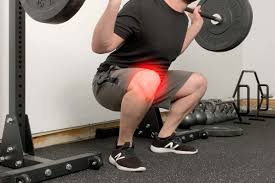
Knee pain during squats is common, but it does not automatically mean squatting is damaging your knees or that you need to stop forever. In many cases, changing the load, range of motion, stance, tempo or squat variation can make the movement more comfortable while you continue building strength.
The goal is not necessarily to find one “perfect” squat technique. It is to find a version your knees tolerate well and gradually build capacity from there.
When Knee Pain Should Be Assessed
Some knee discomfort can often be managed by modifying training, but certain symptoms deserve professional assessment.
Seek medical or physiotherapy advice if you experience:
- significant or unexplained swelling
- locking or an inability to fully bend or straighten the knee
- repeated buckling or giving way
- a traumatic injury
- severe or worsening pain
- redness, heat or other unusual symptoms
Persistent knee pain that is not improving is also worth getting assessed rather than continually training around it.
Pain Does Not Always Mean Damage
Pain is more complicated than simply “something is injured.”
Load, fatigue, previous injuries, sensitivity, sleep, stress and recent changes in activity can all influence how a knee feels.
That means a painful squat is not automatically a dangerous squat.
Often the first step is reducing the demand enough that you can continue moving comfortably.
Check Your Available Range of Motion
Your ankles, knees and hips all contribute to a squat.
If one area has limited mobility, your body may simply choose a different strategy.
For example, limited ankle dorsiflexion may make it harder to squat deeply while keeping the heels grounded.
You can experiment with:
- a slightly shallower squat
- elevating the heels
- holding onto support
- changing stance width
- using a box or bench as a depth target
Range of motion can then be increased gradually.
Your Knees Can Move Over Your Toes
The old rule that your knees should never travel past your toes is overly simplistic.
Forward knee movement is a normal part of many squats, lunges, stairs and everyday movement.
The question is not whether your knees cross an imaginary line over the toes.
The better question is whether the amount of load and range is appropriate for your current capacity.
Knee Tracking Does Not Need to Be Perfect
It is useful to have the knees generally move in a direction that feels natural relative to the feet and hips.
But you do not need to aggressively force the knees outward or keep them perfectly aligned every second.
Human movement includes some natural variation.
If changing foot position or allowing the knees to move more naturally makes the squat feel better, that may be the better option.
Adjust the Range of Motion
You do not need to squat as deeply as possible.
If deeper squats cause pain, reduce the depth temporarily.
For example, use:
- a higher box squat
- a bench squat
- a partial squat
- TRX or supported squats
Then gradually work toward more range if your knee tolerates it.
This is often more useful than completely avoiding squats.
Adjust the Load
Sometimes the exercise is fine and the load is simply too high.
Reduce the weight and see whether the movement becomes more comfortable.
You can rebuild gradually.
A lighter squat performed consistently is often more useful than repeatedly testing a weight that irritates the knee.
Try Slower Tempo Squats
Slowing the movement can help you practice control and reduce the tendency to drop quickly into the bottom position.
Try lowering over three or four seconds, pausing briefly, then standing normally.
Tempo work can make a lighter weight challenging while giving you more time to control the movement.
Experiment With Stance
There is no universally ideal squat stance.
Some people feel better with:
- a slightly wider stance
- a narrower stance
- more toe-out
- less toe-out
Hip anatomy, mobility and individual proportions all affect what feels comfortable.
Experiment within a reasonable range instead of forcing your feet into one prescribed position.
Heel-Elevated Squats
Placing the heels on a small wedge or weightlifting shoe allows the knees to travel forward more easily.
For some people, this makes the squat significantly more comfortable.
Heel elevation also tends to increase the demand on the quadriceps.
It is not cheating.
It is simply another squat variation.
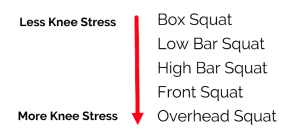
Box Squats
A box or bench gives you a clear depth target.
This can be useful if you are rebuilding confidence or controlling how much knee flexion you use.
Start higher and gradually lower the box over time if appropriate.
Split Squats and Lunges
A painful bilateral squat does not necessarily mean every knee-dominant exercise will hurt.
Sometimes split squats, reverse lunges or supported lunges feel better.
You can adjust:
- stride length
- depth
- support
- load
- torso angle
There is no rule that you need to avoid lunges simply because your knee hurts during one type of squat.
Strengthen the Muscles Around the Knee
Knee rehabilitation and training often involve strengthening much more than the knee itself.
Useful exercises may include:
- squats
- step-ups
- split squats
- leg extensions
- hamstring curls
- calf raises
- hip strengthening
- deadlift variations
The quadriceps are especially important for supporting knee function.
Avoiding knee loading completely can sometimes make the joint less capable rather than more resilient.
What About Low-Bar Squats?
Low-bar squats generally shift more of the work toward the hips and can reduce some knee demand compared with more upright squat variations.
That may feel better for some people.
But low-bar squatting is not automatically the best solution for knee pain.
A heel-elevated squat, box squat, goblet squat or split squat might work better for someone else.
Choose the variation based on the individual, not the label.
Manage Training Volume
Pain often appears after a sudden increase in:
- squat frequency
- weight
- repetitions
- depth
- running
- jumping
- sports activity
Sometimes the knee simply needs less total stress for a while.
Instead of stopping everything, reduce one or two variables and monitor how the knee responds.
Avoid Constantly Training to Failure
You do not need every squat set to be maximal.
Leaving a few repetitions in reserve can help you accumulate quality training without constantly exhausting yourself.
Hard training has a place, but it does not need to be the default for every workout.
Knee Arthritis and Squatting
Having knee osteoarthritis does not automatically mean you should stop strength training.
Appropriately scaled exercise is commonly used to help maintain strength and function.
The right variation, range and resistance depend on the individual.
If arthritis symptoms are limiting you significantly, a physiotherapist can help you build an appropriate progression.
Patellofemoral Pain
Pain around or behind the kneecap is common, particularly during squats, stairs or running.
Exercise is often an important part of managing patellofemoral pain.
Instead of avoiding knee loading completely, the goal is usually to find tolerable levels of activity and gradually build strength and capacity.
What About Meniscus Tears?
Meniscus tears are not all the same.
A traumatic injury with swelling, locking or significant loss of motion should be assessed.
Degenerative meniscus changes are common as people age and do not automatically mean exercise needs to stop.
A healthcare professional can help determine whether symptoms require additional investigation.
Use Pain as Information
You do not need to panic at every sensation.
At the same time, repeatedly pushing through significant pain is not a good training strategy.
Notice:
- how the knee feels during exercise
- whether symptoms increase afterward
- how it feels later that day
- how it feels the following morning
If a modification allows you to train without symptoms escalating, you have probably found a more appropriate starting point.
Squats Are Highly Modifiable
There is no single squat you must perform.
You can use:
- bodyweight squats
- goblet squats
- box squats
- heel-elevated squats
- front squats
- back squats
- split squats
- assisted squats
The best variation is the one you can perform comfortably enough to progressively strengthen.
Build Confidence Gradually
Pain can make people afraid to move.
Reintroducing the movement at a manageable level can help rebuild both physical capacity and confidence.
Progress does not have to mean adding weight every week.
It can also mean:
- squatting slightly deeper
- completing more repetitions comfortably
- using less support
- improving control
- feeling less apprehensive about the movement
For more lower-body strength ideas, read Pistol Squat Progressions: How to Build Strength, Mobility and Control and Mobility vs. Stability: How They Work Together.
If you want individualized help modifying squats and building stronger knees and legs, explore Personal Training in Nanaimo.