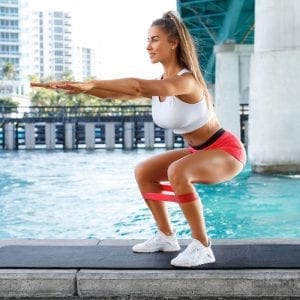
Many people want stronger, more developed glutes, whether for appearance, performance or everyday strength. The glutes play an important role in hip extension, balance, climbing stairs, running, hiking and many other lower-body movements.
It is possible to emphasize the glutes in your training, but you cannot completely isolate them from the thighs. Your quadriceps and hamstrings will still contribute to many lower-body exercises, and genetics also influence how your body responds to training.
Can You Build Your Glutes Without Making Your Thighs Much Bigger?
You can bias your training toward the glutes, but there is no way to guarantee that your thighs will not also gain some muscle.
Muscle growth depends on genetics, training volume, exercise selection, nutrition and how your body responds. Some people naturally build their quadriceps more easily, while others notice more change through the glutes and hamstrings.
Instead of trying to avoid using your thighs altogether, it is usually more helpful to choose exercises that place a strong demand on the glutes and manage the overall amount of quad-dominant training you do.
Focus on Glute Strength
If your goal is to build your glutes, progressive strength training is key. The glutes respond to resistance just like other muscles, which means they need enough challenge over time.
You do not need to train as heavy as possible every session. A better approach is to use a weight or variation that feels challenging while allowing you to maintain good control and technique.
1. Hip Thrusts and Glute Bridges
Hip thrusts and glute bridges are useful for loading hip extension and placing a strong demand on the glutes.
Start with bodyweight if needed, then progress to a dumbbell, barbell or machine. Pause briefly near the top and focus on extending through the hips without over-arching your lower back.
2. Romanian Deadlifts and Hip Hinges
Romanian deadlifts and other hip-hinge variations train the glutes and hamstrings together.
Keep the movement controlled, send the hips back and use a range of motion that allows you to maintain a strong, comfortable position.
You can read more in Deadlift: A Powerful Strength Movement for Everyday Fitness.
3. Kettlebell Swings
Kettlebell swings are a more dynamic hip-hinge exercise. They use the glutes, hamstrings and trunk to create force through the hips.
The swing should come from a powerful hip extension rather than lifting the kettlebell with the arms. If you are new to kettlebells, it can help to learn the hip hinge first before adding speed.
4. Single-Leg Hip Thrusts and Bridges
Single-leg bridge and hip-thrust variations can challenge the glutes without requiring as much external weight.
Keep the pelvis controlled and press through the working foot while lifting the hips. If the single-leg version feels too difficult, use both legs and progress gradually.
5. Split Squats and Step-Ups
Split squats and step-ups are excellent for building single-leg strength and can place a strong demand on the glutes depending on your setup.
Using a slightly longer stance or leaning the torso forward a little can often increase the contribution from the hips. The goal is not to eliminate the quadriceps, but to find a variation that matches your goals and feels good for your body.
6. Squats Still Have a Place
Squats train the glutes, quadriceps and many other muscles together. You do not need to remove them simply because you want to emphasize your glutes.
If your quadriceps tend to dominate, you can balance your program by including more hip thrusts, hinges, single-leg work and other glute-focused exercises rather than relying only on squats.
Nutrition Matters Too
Building muscle requires enough energy and protein to support training and recovery. You do not need an extreme diet, but consistently eating enough protein and following a balanced eating pattern can support muscle growth.
If you are also trying to change body composition, remember that you cannot choose exactly where your body stores or loses fat. Genetics and hormones play a large role in body shape.
For a broader look at this topic, you may also like Body Composition 101: Why Muscle Matters More Than the Number on the Scale.
Be Patient With the Process
Glute development takes time. Progress usually comes from consistent training, appropriate resistance, enough recovery and gradually increasing the challenge.
You may notice changes in strength before you see major visual changes, and that is still meaningful progress.
If you would like help building a lower-body program that emphasizes glute strength, single-leg stability and functional movement, learn more about Personal Training in Nanaimo.