When it comes to improving your health and fitness, having clear goals can give you direction, help you notice progress and make it easier to stay consistent.
A good goal does not need to be extreme. In fact, some of the most useful goals are simple, realistic and connected to what you actually want your life to feel like.
In this article, we’ll look at why goal setting matters, how to use the SMART framework, and how to create health and fitness goals that are both meaningful and achievable.
Why Goal Setting Matters
Goals can help you focus your energy and make your intentions more concrete.
Without a clear goal, it is easy to jump from one idea to another or feel discouraged because you are not sure whether you are making progress.
A useful goal can help you:
- identify what matters most to you
- create a realistic plan
- track progress over time
- stay accountable
- recognize small wins
- adjust when something is not working
Goal setting can also support confidence. When you follow through on something you planned, even in a small way, it can reinforce the belief that you are capable of making meaningful changes.
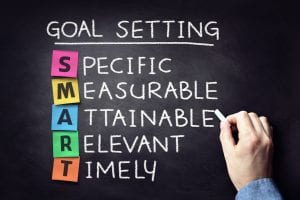
Use the SMART Framework
SMART is a simple framework that can help turn a vague intention into a clearer goal.
S is for Specific
Your goal should be clear enough that you know what you are working toward.
Instead of:
“I want to get in shape.”
Try:
“I want to strength train twice a week for the next eight weeks.”
Specific goals are easier to plan around and easier to evaluate.
M is for Measurable
You should have some way to notice whether you are progressing.
That does not always mean using a scale or a number.
You might track:
- how many workouts you complete
- how much weight you can lift
- how long you can walk or run
- how many push-ups or squats you can do
- how consistently you stretch
- how confident you feel performing a movement
Choose a measure that actually relates to your goal.
A is for Action-Oriented
A goal is more useful when you know what actions will help you reach it.
For example, if your goal is to run a 5K, your action steps might include:
- walking or running three times per week
- gradually increasing your running intervals
- doing strength training once or twice per week
- scheduling your workouts in advance
Focus on the actions you can control.
R is for Realistic
A good goal should challenge you without requiring perfection.
Your goal needs to fit your current schedule, experience, health, responsibilities and available resources.
If a goal feels impossible to maintain, make it smaller.
For example, instead of deciding you will exercise six days per week when you are currently exercising once, you might start with two or three consistent sessions.
Progress does not have to happen all at once.
T is for Time-Based
Giving your goal a time frame can help create structure and give you a point to review your progress.
For example:
“For the next eight weeks, I will complete two strength workouts each week.”
At the end of the eight weeks, you can ask:
What worked?
What did not?
What changed?
What should I continue or adjust?
The deadline is not meant to create pressure. It gives you a natural point to reflect and reassess.
Goal Setting Worksheet
Use these questions to create a goal that works for your real life:
- What would I like to improve over the next one to three months?
- Why is this goal important to me?
- Which days of the week can I realistically exercise?
- How much time can I comfortably commit?
- What barriers might get in the way?
- What strategies could help me work around those barriers?
- What is one small action I can start this week?
- How will I know I am making progress?
- What support would make this easier?
- How do I want to feel as I work toward this goal?
You can also think about goals over different time frames:
- short-term: 1 to 3 months
- medium-term: 3 to 6 months
- longer-term: 6 to 12 months
Your shorter goals can become stepping stones toward the bigger ones.
Health and Fitness Goal Ideas
Your goals do not have to focus on weight.
Some examples include:
- get stronger
- build a consistent exercise routine
- improve mobility or flexibility
- improve balance
- walk or hike farther
- run a 5K
- learn a new movement skill
- improve lifting technique
- feel more confident in the gym
- join a group fitness class
- prepare for a recreational event
- improve energy and daily movement
- become more comfortable getting up and down from the floor
- make movement a regular part of your lifestyle
Choose goals that feel meaningful to you, not simply goals you think you are supposed to have.
Focus on Progress, Not Perfection
Goals can be helpful, but they are not meant to become another way to judge yourself.
Life changes. Schedules change. Motivation changes.
If you miss a workout or your original plan stops working, that does not mean you failed. It simply means you have information you can use to adjust your plan.
Consistency usually comes from flexibility, not perfection.
If you want support creating realistic health and fitness goals, learn more about Personal Training in Nanaimo or Health & Lifestyle Coaching.
For a broader reflection on creating a life that feels meaningful and satisfying, you can also read Building the Life You Want: Finding Pleasure, Satisfaction, and Meaning on Vancouver Island Holistic Counselling.