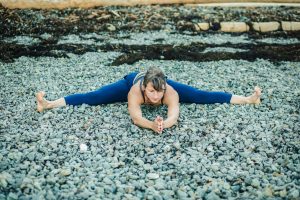
When people think about flexibility, they often imagine yoga poses or full splits. But being able to move into a large range of motion is only part of the picture.
For movements like a middle split or wide straddle, strength matters too. The adductors, hips and trunk all help control the range, especially near end positions.
What Are the Adductors?
The adductors are a group of muscles along the inner thigh.
They help bring the leg toward the midline, but they also contribute to:
- hip control
- pelvic stability
- balance
- walking and running
- changing direction
- controlling wide-leg positions
They are not simply “inner thigh muscles that need stretching.”
Strength and Mobility Work Together
Mobility is the ability to move through a useful range with control.
That means a person may be able to passively stretch into a wide position but still lack the strength to control that range.
For splits and deep hip positions, strength can be especially important near the end of the available range.
That is why I prefer combining flexibility work with strengthening rather than only stretching.
Hip Anatomy Matters
Not everyone has the same hip structure.
Differences in femur shape, socket depth and orientation can influence which positions feel natural and how much range is available.
That means not everyone needs to achieve the same depth or angle.
A full middle split is not a measure of overall fitness.
The Middle Split Is Not Just About Stretching
A middle split challenges more than passive flexibility.
It also requires:
- adductor length
- adductor strength
- hip control
- trunk stability
- confidence near end range
That combination is why simply forcing yourself lower is not the best strategy.
Eccentric Strength
Eccentric strength means a muscle is producing force while lengthening.
For the adductors, this can be useful when lowering into a wider stance or controlling a split progression.
Slow, controlled movement can help you build tolerance in the range you are trying to access.
A Safer Sliding Progression
Sliding exercises can be useful, but they need control.
If you use socks on a smooth floor, make sure you have something stable to hold onto.
Start with a small range.
Slide the feet apart slowly, pause, then use the legs to return.
Do not keep sliding until you lose control.
The goal is to strengthen the range, not test the deepest position possible.
Use Support
A chair, bench, railing or suspension trainer can help you control the movement.
Support is especially useful when learning wide-stance strength work.
It allows you to reduce how much bodyweight the adductors need to manage.
As strength improves, you can gradually rely less on support.
Seated Straddle Strength
From a seated wide-leg position, you can practice active hip control.
Try lifting one heel or leg slightly from the floor.
Keep the movement small and controlled.
This challenges the muscles that help you actively use the range rather than simply resting in it.
Cossack Squats
Cossack squats are another useful exercise for combining strength and mobility.
Shift toward one side while keeping the other leg longer.
Use a small range first.
You can hold onto support if needed.
The movement challenges the adductors, hips and balance at the same time.
Copenhagen Plank
The Copenhagen plank is a more advanced adductor-strength exercise.
Support the top leg on a bench and lift the body into a side-plank position.
Start with the knee supported rather than the ankle if you are new to it.
This exercise can create a lot of inner-thigh demand, so progress gradually.
Side Lunges
Side lunges are a practical way to strengthen the hips through lateral movement.
Step wide, shift the hips back and bend one knee while the other leg stays longer.
Keep the range comfortable.
These can be loaded later with dumbbells or kettlebells.
Do You Need to Stretch the Adductors?
Sometimes.
If a gentle stretch feels good and helps you access a range more comfortably, it can be useful.
But constantly stretching a muscle that feels “tight” is not always the answer.
Sometimes that feeling improves more when you strengthen the muscle through range.
Warm Up Before Deep Range Work
You do not need a long warm-up, but it helps to prepare the body before deeper mobility work.
Try:
- light walking or cycling
- bodyweight squats
- side lunges
- hip circles
- Cossack squats
- gentle dynamic adductor movements
Then move into deeper range gradually.
Progress Does Not Need to Be Daily
You do not need to work on splits every day.
Two or three focused sessions per week may be enough for many people.
Your tissues need time to adapt to loading.
More is not always better.
Pain Is Not the Goal
A stretching sensation is different from sharp, pinching or tearing pain.
Back off if you feel:
- sharp groin pain
- pinching in the hip
- sudden loss of control
- pain that lingers or worsens afterward
If symptoms persist, get assessed by a physiotherapist or other appropriate healthcare professional.
Build the Whole Hip
The adductors are only one part of hip function.
A balanced program can also include:
- glutes
- abductors
- hip flexors
- hamstrings
- quadriceps
- trunk strength
The goal is not to create a perfectly flexible hip.
It is to create a hip that is strong and adaptable in the ranges you use.
Splits Are Optional
You do not need a middle split to be mobile, athletic or healthy.
For some people, splits are a fun skill goal.
For others, they are unnecessary.
The best mobility goal is one that supports what you actually want to do.
Strength First? Not Always
I would slightly change the old “strength first, then mobility” message.
A better idea is:
build strength and mobility together.
You can work on controlled range, stretching and strength at the same time.
That tends to be more useful than treating them as separate phases.
For more, read Mobility vs. Flexibility: What’s the Difference and Why Does It Matter? and Why I Don’t Just Stretch My Hips — I Strengthen Them.
If you want individualized help with hip strength, flexibility or split progressions, explore Personal Training in Nanaimo or Yoga & Mobility Classes in Nanaimo.