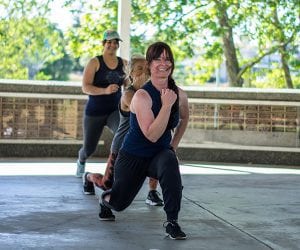
 High-Intensity Interval Training, or HIIT, is a training style that alternates harder efforts with periods of rest or easier movement. One of the reasons it became so popular is simple: it can create a challenging workout in a relatively short amount of time.
As a busy mom, I started using more interval training because I did not always have long stretches of time for exercise. I liked being able to focus on the movement in front of me, use a timer instead of constantly counting repetitions, and get a lot of work done in a shorter session.
What Is HIIT?
HIIT usually involves short periods of higher-intensity exercise followed by rest or lower-intensity recovery. The exact work-to-rest ratio can vary depending on the exercise, your fitness level and the goal of the workout.
HIIT can be used with cardio, bodyweight exercises, kettlebells, rowing, cycling or strength-based circuits. It can help improve cardiovascular fitness and conditioning, but it does not need to be performed at absolute maximum effort every time to be effective.
Why HIIT Can Work Well for Busy People
HIIT can be useful when time is limited because the workout structure is focused and efficient. A session can be 10 to 20 minutes and still feel challenging.
That does not mean HIIT is automatically better than every other type of exercise. Walking, strength training, mobility work, yoga and longer steady-state cardio all have value too. HIIT is simply one useful tool you can add to a balanced routine.
1. 30 Seconds Work / 10 Seconds Rest
Choose four exercises, for example:
- squats
- push-ups
- reverse lunges
- plank or dead bug
Set a timer for 30 seconds of work and 10 seconds of rest. Move through the four exercises in a circuit and repeat for four rounds.
This gives you a short full-body workout without needing to count every repetition.
2. Tabata: 20 Seconds Work / 10 Seconds Rest
Traditional Tabata uses 20 seconds of hard work followed by 10 seconds of rest for eight rounds, for a total of four minutes.
You can use one exercise for all eight rounds or alternate between two exercises. Examples include squats, cycling, rowing, mountain climbers, kettlebell swings or step-ups.
Choose an intensity you can maintain with good form. You do not need to treat every interval like an all-out sprint.
3. 12 Seconds Moderate / 8 Seconds Harder
This variation uses two different intensity levels without a full rest.
For example, you might perform bodyweight squats for 12 seconds, then move into a faster squat variation for 8 seconds. Repeat the sequence three times for a total of one minute.
You can also use lower-impact combinations, such as marching for 12 seconds followed by faster high-knee marching for 8 seconds.
This type of interval can become intense quickly, so use it selectively rather than making every exercise a maximum-effort drill.
4. 45 Seconds Work / 15 Seconds Rest
Choose one or two exercises and work for 45 seconds, then rest for 15 seconds.
For example, with step-ups, you could work one side for 45 seconds, rest for 15 seconds, then switch sides. Repeat for several rounds.
Use a stable step or bench rather than a chair if possible, and choose a height that allows you to move with control.
HIIT With Strength Training
Interval training can also be combined with resistance exercises. You might alternate rows, squats, presses, lunges or kettlebell movements with short rest periods.
However, strength training and HIIT are not exactly the same thing. If your goal is to build maximum strength, longer rest periods are often useful because they allow you to use more resistance and maintain better technique.
HIIT works especially well when your goal is conditioning, variety or a time-efficient workout.
How Hard Should HIIT Feel?
HIIT should feel challenging, but “hard” is relative.
A beginner might use brisk walking, bodyweight squats and wall push-ups. A more experienced person might use running, rowing, kettlebell swings or more demanding bodyweight exercises.
You should still be able to maintain control and recover between intervals. If your form breaks down or you feel dizzy, unusually short of breath or unwell, stop and recover.
How Often Should You Do HIIT?
For many people, one or two HIIT sessions per week is enough, especially if you are also strength training and doing other forms of activity.
More HIIT is not always better. Recovery, sleep and the rest of your training week matter too.
If you want more interval ideas, you can also try 5 HIIT Workouts Under 20 Minutes.
If you enjoy training with other people, explore Group Fitness Classes in Nanaimo. If you want a program tailored to your goals and fitness level, learn more about Personal Training in Nanaimo.
Keep HIIT as One Tool in Your Fitness Routine
HIIT can be fun, challenging and efficient, especially when you are short on time. But it does not need to replace strength training, mobility work or lower-intensity movement.
Use it when it fits your goals, start at an intensity appropriate for you, and give yourself enough recovery to keep progressing.