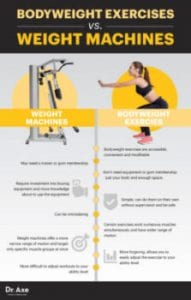
Bodyweight training and weight training are both effective ways to build strength, improve fitness and support long-term health. The better choice depends on your goals, experience, available equipment and what you actually enjoy doing consistently. For most people, the strongest approach is not choosing one or the other, but understanding how each can fit into a balanced routine.
Bodyweight Training
Bodyweight training uses your own body as resistance. Common exercises include squats, lunges, push-ups, pull-ups, planks, step-ups and many calisthenics movements. One of its biggest advantages is convenience: you can train almost anywhere without needing much equipment, which makes it useful for home workouts, travel or days when you cannot get to a gym.
Bodyweight exercises can also be adapted to different levels. A push-up might begin against a wall or bench and gradually progress toward the floor. Squats can be performed to a chair before progressing to deeper or single-leg variations. As your strength improves, you can make exercises harder by changing leverage, range of motion, tempo or stability.
Bodyweight training is not automatically easier than weight training. Some movements, such as pull-ups, dips, pistol squats and advanced push-up variations, can be very demanding. The key is choosing a version that matches your current ability.
Weight Training
Weight training uses external resistance such as dumbbells, kettlebells, barbells, cables or machines. One of its main advantages is that resistance can be adjusted very precisely, which makes it easier to progressively challenge the body over time.
This can be especially useful when your goals include building strength or muscle. For example, if a bodyweight squat becomes easy, adding dumbbells or a barbell allows you to continue increasing the challenge without needing to switch immediately to a much more complex exercise.
Weight training can also be very accessible for beginners. Machines, cables and light dumbbells can sometimes make an exercise easier to scale than a bodyweight version. For example, an assisted pull-up or lat pulldown may be more appropriate than asking someone to perform a full bodyweight pull-up before they are ready.
Is Bodyweight Training Better for Beginners?
Not necessarily. A beginner can start successfully with either method. What matters is selecting exercises that are appropriate for their current strength, mobility and confidence.
For some people, a chair squat, wall push-up and bodyweight bridge may be an excellent starting point. For someone else, a leg press, cable row and light dumbbell press may actually feel more manageable because the resistance and range of motion can be adjusted easily.
If you are returning from an injury or dealing with pain or significant movement limitations, the exercise should be adapted to you rather than assuming that bodyweight training is automatically the safest option.
Which Is Better for Building Strength and Muscle?
Both can build strength and muscle when they provide enough challenge and progress over time. External weights often make progression simpler because you can gradually increase resistance in small amounts, but advanced bodyweight exercises can also create a very high level of resistance.
The most important principle is progressive overload: gradually asking your muscles to do more over time. That might mean lifting a little more weight, completing more repetitions, improving your range of motion, slowing the movement down or progressing to a more challenging exercise variation.
What About Mobility and Functional Movement?
Both types of training can support mobility and functional movement when exercises are performed through appropriate ranges of motion. Neither method automatically improves flexibility more than the other. A well-designed program can combine strength and mobility regardless of whether you are using your body weight, dumbbells, machines or other equipment.
Movements such as squats, lunges, carries, pushes, pulls and hip hinges can all be trained in different ways depending on your goals and abilities. If you are interested in how the hips and core contribute to movement, you can also read Understanding and Strengthening the Psoas Muscle: Key to Mobility and Core Stability.
The Best Approach: Use Both
For many people, combining bodyweight and external resistance gives the most variety and flexibility. You might use bodyweight exercises for warm-ups, mobility work, push-ups, planks or travel workouts, while using dumbbells, kettlebells or machines for exercises where you want more precise resistance.
A balanced strength program could include a mix of squats, rows, presses, lunges, carries, pull-ups or pulldowns, deadlift variations and core exercises. The exact combination matters less than choosing movements you can perform well and progress over time.
If you would like help building a program that fits your goals, equipment and current ability, learn more about Personal Training in Nanaimo. You can also explore Group Fitness Classes in Nanaimo if you enjoy strength training in a group environment.
Choose the Training You Can Sustain
There is no universal winner between bodyweight training and weight training. Both can help you become stronger, fitter and more capable. The best method is the one that matches your goals, gives you an appropriate challenge and is realistic enough to keep doing consistently.