Hanumanasana, or the yoga splits, is a deep mobility pose that asks for significant range through the front of one hip and the hamstrings of the other leg. It can be a meaningful pose to work toward, but it is best approached as a gradual process rather than a test of flexibility.
This sequence focuses on preparing the hips, hamstrings and trunk while removing the idea that tightness in the psoas directly stores fear or trauma.
What the Psoas Actually Does
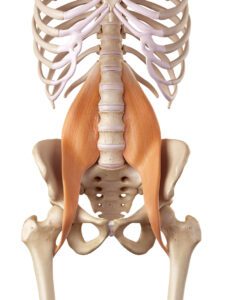
The psoas is an important hip flexor that helps bring the thigh toward the torso and contributes to trunk and hip movement.
It can feel tight or overworked for many reasons, including sitting, repetitive activity, guarding after pain, training load and individual anatomy.
Stress can influence muscle tension generally, but the psoas is not a special “fear muscle,” and stretching it does not literally release fear or trauma from the body.
Why Hanumanasana Is Challenging
A full split requires a lot of mobility through both legs at the same time.
The front leg needs hamstring length, while the back leg needs hip extension through the hip flexors and quadriceps.
It also requires enough strength and control to support that range.
Warm Up First
Begin with a few minutes of gentle movement.
Useful options include:
- Cat-Cow
- kneeling hip circles
- Low Lunge
- Half Split
- glute bridges
- hamstring sweeps
- Sun Salutations
Avoid dropping straight into your deepest stretch before the body is warm.
Low Lunge
Step one foot forward into a Low Lunge.
Keep the pelvis comfortable and gently shift forward until you feel a stretch through the front of the back hip.
Do not force the pelvis to square perfectly.
Stay for a few breaths.
Half Split
Shift the hips back and straighten the front leg as much as comfortable.
Keep a soft bend in the knee if needed.
Use blocks under the hands so you do not have to collapse forward.
Move slowly between Low Lunge and Half Split several times.
Pyramid Pose
Straighten both legs into Pyramid Pose.
Keep the stance wide enough to feel stable.
Think about length through the spine rather than trying to bring the chest to the thigh.
Standing Split
Shift weight into the front foot and lift the back leg.
Use blocks or a wall for support.
Standing Split is useful for exploring hamstring length and single-leg control without forcing a floor split.
Warrior III
From standing, hinge forward into Warrior III.
Keep the standing leg strong and the pelvis comfortable.
This adds active strength to the mobility work.
Pigeon or Figure Four
Use Pigeon only if it feels comfortable in your knees and hips.
A reclining Figure Four can be a better choice for many bodies.
There is no need to force the hip into a deep external rotation shape.
Seated Hamstring Work
Try:
- Staff Pose
- Head-to-Knee Pose
- Wide-Leg Seated Forward Fold
Keep the spine long and use a strap if needed.
Think of these as preparation, not a competition to reach farther.
Hanumanasana Progression
From Low Lunge, begin sliding the front foot forward and the back knee backward.
Place blocks under your hands.
Stop well before the point where you feel sharp pain or strain.
You can also place a bolster, folded blanket or block under the pelvis so the pose is supported.
The front knee can remain slightly bent.
You do not need to reach the floor for the pose to be useful.
Use Active Strength
Instead of simply hanging in the stretch, gently press the front heel down and back and the back knee down and forward.
This creates muscular engagement around the range you are using.
Active control is often more useful than passive stretching alone.
PNF-Style Stretching
If you use contract-relax or PNF techniques, keep the contractions gentle.
For example, in a hamstring stretch you might press the heel lightly into the floor for a few seconds, then relax.
Avoid maximal effort.
If you are unsure how to use these techniques, work with someone experienced in mobility or rehabilitation.
What Hanumanasana Can Help Develop
Hanumanasana can challenge:
- hamstring flexibility
- hip flexor mobility
- quadriceps length
- pelvic control
- patience
- body awareness
It is better not to claim that it directly improves anxiety, mental clarity, digestion or “releases stored trauma.”
The Story of Hanuman
Hanumanasana is named after Hanuman, an important figure in the Ramayana who is associated with courage, devotion and service.
The pose is often linked symbolically with Hanuman’s great leap.
That story can be a meaningful part of yoga philosophy if it resonates with you, but it is best presented as traditional context rather than as a medical explanation for what the pose does.
Finish With Recovery
After deep hip and hamstring work, include slower movements such as:
- Supported Bridge
- Reclining Figure Four
- Supine Twist
- constructive rest
- Savasana
Let the muscles settle instead of immediately pushing into another deep stretch.
Mobility Does Not Need to Be Forced
A full split is not necessary for health, fitness or a meaningful yoga practice.
Some people will reach the floor easily. Others may never do so because of anatomy, injury history or training priorities.
The goal is not the final shape.
The goal is to build usable range with enough strength and control to feel good in it.
If you want help building hip and hamstring mobility, explore Yoga & Mobility Classes in Nanaimo or Personal Training in Nanaimo.
You may also enjoy Mobility vs. Flexibility: What’s the Difference?.