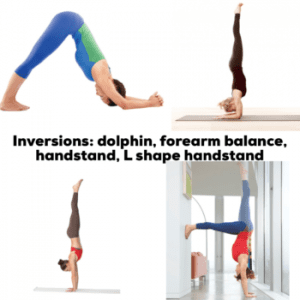
 Inversions can be exciting, challenging and intimidating. They ask you to support your body in a different relationship to gravity, which can develop strength, coordination, balance and body awareness.
This class was originally created as part of a yoga lesson-plan series. It includes preparatory core work, forearm strength, wall-supported inversions and slower finishing poses. The goal is not to force yourself upside down, but to build the skills gradually and choose the level that feels appropriate for you.
What Counts as an Inversion?
In yoga, an inversion generally refers to a position where the heart is above the head or the body is partially or fully upside down.
Examples can include:
- Downward-Facing Dog
- Dolphin Pose
- Standing Forward Fold
- Legs-Up-the-Wall
- Shoulderstand
- Headstand
- Forearm Balance
- Handstand
Not every inversion requires balancing on the head or hands.
What Inversions Can Help You Develop
Inversions can challenge:
- upper-body strength
- shoulder stability
- core control
- balance
- coordination
- spatial awareness
- confidence with unfamiliar movement
They can also demand a lot of concentration, which may help you feel very present during the practice.
I would avoid claiming that inversions automatically improve brain function, lymphatic drainage or cardiovascular health. Their clearest benefits are physical skill, strength and movement control.
Start With Hamstrings and Spinal Movement
Begin on your back with a gentle hamstring stretch.
You can use a strap around one foot and keep the opposite leg bent or extended depending on what feels comfortable.
Add a few slow spinal rolls or knee-to-chest movements to warm up the trunk.
Core Preparation
Move into Boat Pose and a lower Boat variation.
You can also use a block between the hands or forearms to create gentle tension and improve awareness through the shoulders and core.
Try:
- Boat Pose
- Half Boat
- Hollow-body hold
- slow knee tucks
Keep the breath steady.
Warm Up the Wrists and Shoulders
Before loading the upper body, spend time preparing the wrists and shoulders.
From hands and knees, try:
- gentle forward and backward wrist rocking
- Cat-Cow
- shoulder-blade protraction and retraction
- Plank
- Downward-Facing Dog
If the wrists are sensitive, spend more time in forearm-based positions.
Dolphin Pose
From Downward-Facing Dog, lower onto the forearms.
Press the forearms into the floor and lift the hips into Dolphin.
This is a useful preparation for Forearm Balance because it develops shoulder strength and introduces the feeling of having more weight above the shoulders.
Dolphin to Forearm Plank
Move slowly between Dolphin and Forearm Plank.
This can help build:
- shoulder endurance
- core control
- awareness of the relationship between ribs, pelvis and shoulders
Repeat only as long as you can maintain good control.
Forearm Side Plank
From Forearm Plank, rotate into a supported Side Plank variation.
Keep the bottom knee down if needed.
This adds lateral core strength and shoulder stability before you move into more demanding inversions.
Sun Salutation and Standing Preparation
Move through a few Sun Salutations to warm the whole body.
You might include:
- Downward-Facing Dog
- One-Legged Dog
- Crescent Lunge
- Standing Hand-to-Big-Toe variation
- Standing Split
These poses can help prepare the hamstrings, hips and balance needed for inversion work.
Handstand Preparation at the Wall
The wall can make handstand training much safer and less intimidating.
Start with simple weight-shifting drills rather than trying to kick all the way up.
You might practice:
- small handstand hops
- one-leg kick-ups
- L-shaped Handstand with feet on the wall
- wall walks
- holding a supported position for a few breaths
Avoid repeated hard kicking if you do not yet have the shoulder strength and control to receive your body weight.
L-Shaped Handstand
Place the feet on the wall at roughly hip height and walk the hands forward until the hips stack more directly over the shoulders.
This is a great way to experience the inverted shape without balancing freely.
Keep the elbows straight but not locked aggressively, and press the floor away.
Forearm Balance Preparation
Return to Dolphin and practice shifting the shoulders forward.
Try lifting one leg at a time.
If you are working with a wall, use it as support rather than kicking forcefully.
Forearm Balance requires significant shoulder mobility and strength, so there is no need to rush it.
Headstand: Approach With Care
Headstand places much more demand on the neck than poses like Downward Dog or Handstand.
It is not appropriate for everyone and is best learned in person from an experienced teacher.
If you practice it, focus on building support through the forearms and shoulders rather than dumping body weight into the head.
Beginners can get many of the benefits of inversion practice from Dolphin, L-shaped Handstand and wall-supported drills without doing Headstand at all.
When to Skip or Modify Inversions
Avoid or modify inversions if you have an injury or condition that makes them inappropriate, especially issues involving the neck, shoulders, wrists, eyes, cardiovascular system or balance.
If you are pregnant or have a medical condition and are unsure whether inversions are appropriate, check with a qualified healthcare professional.
Stop if you experience pain, numbness, dizziness, visual changes or unusual pressure.
Come Back Down Slowly
After inversion work, give the body time to settle.
Try:
- Thunderbolt Pose
- Cow Face arm stretch with a strap
- gentle shoulder stretches
- Child’s Pose
- Supine Twist
- Savasana
Avoid jumping straight from an intense inversion into another demanding movement.
Inversions and Confidence
One reason people enjoy inversions is that they can change your perspective both literally and mentally.
Learning to support yourself upside down can feel empowering, but confidence comes from preparation, not from forcing the pose.
Progress might mean holding Dolphin longer, feeling steadier in an L-shaped Handstand or simply becoming less afraid of weight-bearing through the arms.
That is still progress.
Stay Present Rather Than Chasing the Pose
Inversion practice can become very goal-oriented.
Try to notice what you are learning along the way: how you breathe under effort, how your shoulders respond, how you manage fear and how your balance changes from day to day.
You do not need to achieve a free-standing Handstand for the practice to be valuable.
If you want to explore strength, mobility and inversion preparation in person, learn more about Yoga & Mobility Classes in Nanaimo or Personal Training in Nanaimo.