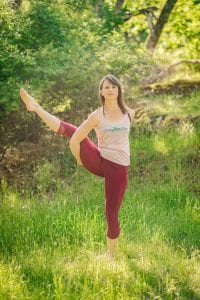
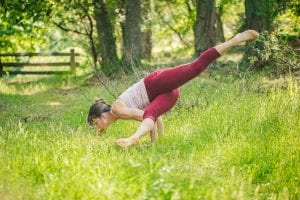
Bird of Paradise, or Svarga Dvijasana, is a challenging standing balance that combines hip mobility, hamstring flexibility, shoulder mobility and control. Eka Koundinyasana II, sometimes called Flying Split, adds an arm-balance element that requires upper-body strength, core engagement and confidence with shifting weight into the hands.
This sequence can be used as an advanced yoga flow or as a framework for progressively building toward those poses. The emphasis should be on preparation and control rather than forcing the final shape.
Begin With Malasana
Start in a low squat, or Malasana.
Keep the feet in a position that feels natural for your hips and use a block under the pelvis if needed.
Add a gentle twist, then explore a bind only if the shoulders and hips feel ready.
Lizard Lunge
Step one leg back into Lizard Lunge.
You can keep both hands on the floor or use blocks.
Move between a gentle Cow-like lift of the chest and a rounded Cat-like shape through the spine.
Keep the movement slow and controlled.
Wild Thing
From Downward-Facing Dog or Side Plank, transition into Wild Thing if it feels appropriate.
This pose combines shoulder loading, hip opening and spinal extension, so use a smaller range if needed.
You can always substitute Side Plank or a supported backbend.
Side Plank
Move into Vasisthasana, or Side Plank.
Keep the lower knee down for more support or stack the feet for a stronger variation.
The goal is to create stability through the shoulder and trunk.
Warrior II
Step forward and come into Warrior II.
Adjust the stance so you feel grounded.
Stay for a few breaths and let the front knee bend comfortably.
Reverse Warrior
Reach the front arm up and back.
Keep length through the side body rather than collapsing into the lower back.
Side Angle With an Optional Bind
Move into Side Angle Pose.
You can keep the forearm on the thigh, place the lower hand on a block or explore a bind if the shoulders allow it.
The bind is optional.
Bird of Paradise Preparation
From bound Side Angle, begin shifting weight into the front foot.
Step the back foot forward and slowly rise while keeping the bind.
Once upright, bring the bound knee toward the chest.
Stay here before attempting to straighten the leg.
Bird of Paradise
If balance and mobility allow, begin extending the lifted leg.
You do not need to fully straighten it.
Keep the standing leg strong and the chest lifted.
A strap can be used instead of a full bind if the shoulders are tight.
Come Down With Control
Bend the lifted knee before lowering.
Return carefully to Side Angle or release the bind and step back into Warrior II.
Avoid dropping out of the pose quickly.
Skandasana
Move toward the back of the mat into Skandasana.
Keep the heel down if possible, or modify the depth.
Use the hands or a block for support.
The goal is to explore lateral hip mobility, not to force a deep side squat.
Half Moon
Transition toward Half Moon, or Ardha Chandrasana.
Use a block under the lower hand or practice against a wall.
This is another useful way to train single-leg balance before returning to the floor.
One-Legged Downward Dog
From Half Moon, return through Warrior II and transition back to Downward-Facing Dog.
Lift one leg and bend the knee to explore hip opening.
Keep the shoulders steady and avoid twisting excessively.
Prepare for Eka Koundinyasana II
Bring the lifted knee toward the outside of the upper arm.
Shift the shoulders forward and bend the elbows slightly.
Keep the back leg active.
You can stay here and work on the shape without lifting both feet.
Eka Koundinyasana II
If you have the strength and control, begin extending the front leg while lifting the back leg.
Think of it as a progression from a strong lunge-arm balance rather than a pose you need to force.
Keep the elbows stable and come out if the shoulders or wrists feel strained.
Take a Vinyasa or Rest
After the arm balance, move through a Vinyasa if it feels good, or rest in Child’s Pose.
You do not need to repeat advanced arm balances multiple times in one practice.
What Bird of Paradise Can Help Develop
Bird of Paradise can challenge:
- single-leg balance
- hip mobility
- hamstring flexibility
- shoulder mobility
- coordination
- core control
I would avoid claiming that it directly reduces anxiety, boosts vitality or guarantees improved self-confidence.
What Flying Split Can Help Develop
Eka Koundinyasana II can challenge:
- upper-body strength
- wrist tolerance
- core control
- hip mobility
- coordination
- confidence with arm balances
The real benefit comes from the progression work, not just from achieving the final pose.
Use Philosophy as Reflection, Not Certainty
You can use this practice to reflect on effort, change and patience.
That can be more useful than attaching absolute spiritual claims to the post.
If mantra or traditional symbolism is part of your personal practice, it can still be meaningful, but it is better presented as one optional layer of yoga rather than a universal truth.
Finish With a Slow Cooldown
After the stronger work, include slower poses such as:
- Child’s Pose
- Reclining Figure Four
- Supine Twist
- Supported Bridge
- Savasana
Let the breath settle before ending the practice.
If you want to explore advanced yoga progressions in person, learn more about Yoga & Mobility Classes in Nanaimo.
You may also enjoy Dancer Pose and Bow Pose Progressions and Crow Pose Progressions for Strength, Balance and Confidence.