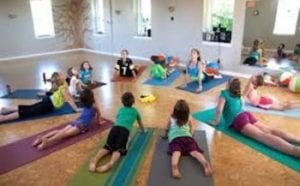
A garden theme is a fun way to introduce children to yoga through imagination, nature and movement. It works especially well with toddlers and younger children because the poses can become seeds, trees, butterflies, frogs and other familiar parts of the natural world.
This lesson can be adapted for parents, teachers, yoga instructors or group leaders. Keep it playful, flexible and short enough to match the children’s attention span.
Theme: Patience
A garden is a natural way to explore patience because plants need time to grow.
You might ask children:
- What do you have to wait for?
- What is something that took you a long time to learn?
- What happens after you plant a seed?
- Can we make a flower grow instantly?
Keep the conversation simple and let the children share their own ideas.
Start With a Welcome Song
Begin with a familiar hello or movement song to help everyone settle into the group.
You can also introduce a simple sound such as “Om” if that is part of your teaching style. Rather than giving it a complicated explanation, invite the children to notice the vibration and sound together.
The goal is simply to create a calm transition into the class.
Mountain Pose
Stand tall with the feet grounded and arms relaxed.
Invite the children to imagine they are mountains beside the garden.
They can reach their arms overhead, sway slightly like trees in the wind or stand very still and strong.
Seed to Tree
Start curled up in Child’s Pose like a tiny seed under the soil.
Slowly begin to grow:
- Lift the head.
- Come onto the knees.
- Rise to standing.
- Reach the arms toward the sun.
- Finish in Tree Pose.
For young children, a parent or partner can offer a hand for balance.
Snake Pose
Lie on the belly and gently lift the chest into a small Cobra Pose.
Pretend to be a snake moving through the garden.
Children can make a soft “ssssss” sound as they breathe out.
Keep the movement small and comfortable rather than asking them to lift as high as possible.
Butterfly Pose
Sit with the soles of the feet together and knees open.
Flap the knees gently like butterfly wings.
Ask the children where their butterfly is flying.
Maybe it lands on a flower, a tree or another part of the garden.
Frog Pose
Come into a comfortable squat or use a wide-legged position.
Children can pretend to be frogs sitting beside a pond.
Add small hops if the group has enough space and the children can land safely.
Cat and Cow
Come onto hands and knees.
Move slowly between a rounded back and a gently extended spine.
You can make animal sounds or turn it into a story about a cat wandering through the garden.
Downward-Facing Dog
Lift the hips into Downward-Facing Dog.
Pretend to be a dog exploring the garden.
Children can bend one knee and then the other, wag their “tail” or make dog sounds.
Upward-Facing Dog or Cobra
Lower back to the belly and lift the chest gently.
For younger children, Cobra is often an easier option than a full Upward-Facing Dog.
Ask them what their dog can see in the garden.
Flower Pose
Sit and create a flower shape with the body.
You can bring the feet together in Butterfly and lift the arms like petals, or invent your own flower pose as a group.
Let each child choose what colour their flower is.
Bee Breath
Sit comfortably and take a gentle breath in through the nose.
As you breathe out, make a soft humming sound like a bee.
Repeat a few times.
Keep it playful rather than focusing on doing the breathing technique perfectly.
Garden Movement Game
Call out different things found in a garden and let the children create movements for each one.
For example:
- Seed — curl into a ball
- Tree — stand tall
- Butterfly — flap wings
- Frog — squat or hop
- Bee — buzz and move around
- Snake — slither low
- Rain — wiggle fingers downward
- Sun — reach arms overhead
You can gradually speed up or let the children take turns calling out the next movement.
Planting a Pretend Garden
Pretend to dig the soil, plant seeds, cover them, water them and wait for them to grow.
Children can act out the whole process with their bodies.
This is a nice way to combine imaginative play with squatting, reaching, kneeling and standing.
Garden Relaxation
Finish by inviting everyone to lie down comfortably.
You might guide a short visualization:
“Imagine you are lying in a warm garden. You can feel the sun, hear the birds and smell the flowers. Your body is quiet and still, like a seed resting in the earth.”
Keep the relaxation brief for young children.
Keep Kids Yoga Playful
The goal is not perfect poses.
Kids yoga is most effective when children are free to imagine, move, explore and participate at their own level.
A garden theme can support movement, creativity and simple ideas like patience without turning the class into a lecture.
For another themed lesson, try Kids Yoga Lesson Plan: Going Into Space or Kids Yoga Lesson Plan: Beach & Ocean Theme.
If you enjoy leading creative movement with children, you may also be interested in the Circus Arts Leader Certification.