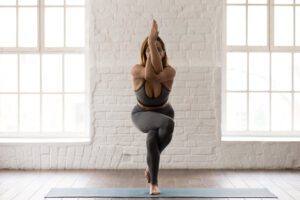
 Eagle Pose, or Garudasana, is a standing balance that combines single-leg strength, coordination, shoulder mobility and body awareness. It can feel compact and challenging, which makes it a useful pose for practicing focus without needing to force a large range of motion.
This sequence builds around Eagle Pose and includes standing strength, balance and slower recovery work.
What Eagle Pose Can Help You Develop
Eagle Pose can challenge:
- single-leg balance
- coordination
- hip and ankle stability
- upper-back and shoulder mobility
- body awareness
- concentration
The wrapped position may also create a feeling of stretch across the upper back and outer hips, depending on your anatomy.
Start With Eagle on Your Back
Lie on your back and cross one thigh over the other.
You can also wrap the arms into Eagle Arms.
This lets you explore the shape without needing to balance.
Try gently drawing the elbows and knees toward one another, then relax.
Warm Up With Sun Salutations
Move through a few rounds of Sun Salutation A and B.
Keep the pace steady enough that you can breathe comfortably.
Use the warm-up to prepare the shoulders, hips and legs before adding balance work.
Eagle Pose
Stand tall and shift weight into one leg.
Cross the opposite thigh over the standing leg.
You can:
- keep the toes on the floor
- wrap the foot behind the calf
- use a wall for support
For the arms, cross one arm under the other and either press the backs of the hands together or wrap the forearms.
Sit back slightly and keep the standing foot grounded.
Eagle Crunch
From Eagle Pose, draw the elbows and knees slightly toward one another.
Move slowly and keep the range small.
This adds more core and balance challenge.
Return to upright before repeating.
Crescent Lunge to Warrior I
Unwind from Eagle and step back into Crescent Lunge.
Then transition into Warrior I.
Keep the front knee comfortable and adjust the stance until you feel stable.
Warrior II
Open into Warrior II.
Let the hips organize naturally rather than forcing them into one exact position.
Stay for a few breaths.
Side Angle Pose
Bring the forearm to the thigh or the hand to a block.
Reach the top arm overhead or keep it on the hip.
Choose the version that lets you keep breathing comfortably.
Triangle Pose
Straighten the front leg and move into Triangle.
Use a block if needed.
Think about length through the torso rather than trying to reach the hand as low as possible.
Wide-Leg Forward Fold With Twist
Step the feet wide and fold forward.
Place one hand on the floor or a block and rotate gently through the upper body.
Repeat on the other side.
Eagle With Warrior III
Return to Eagle Pose.
From there, experiment with Eagle Arms while hinging into Warrior III.
Keep the standing knee soft and use a wall if needed.
This variation adds a larger balance challenge, so treat it as optional.
Warrior I With Eagle Arms
Step back into Warrior I while keeping the Eagle Arm shape.
Notice how the shoulder position changes the experience of the pose.
If the shoulders feel compressed, release the arms.
Side Angle and Triangle With Arm Variations
Move through Side Angle and Triangle again.
You can keep Eagle Arms, reach the top arm overhead or use another comfortable arm position.
There is no need to bind unless it feels easy and spacious.
Legs Up the Wall
After the standing work, transition into Legs Up the Wall or a wide-leg wall variation.
This is a good place to slow down after balance and strength work.
Stay for several comfortable breaths.
Finish With Savasana
End in Savasana or another resting position.
Let the legs and shoulders relax and notice how the body feels after the more compact Eagle shapes.
Use Eagle as a Focus Practice
Because Eagle Pose asks for balance, wrapping and concentration at the same time, it can be a useful way to practice attention.
That does not mean it automatically reduces anxiety, boosts immunity or “detoxifies” the body.
The value is simpler: it gives you a clear physical task that requires awareness and control.
A Note on Garuda
Garudasana takes its name from Garuda, an important figure in Hindu tradition.
If that symbolism is meaningful to you, you can use it as a reflection on perspective, strength or clarity.
It is better to present that as part of yoga tradition rather than as a universal spiritual interpretation.
If you want to explore balance-focused yoga in person, learn more about Yoga & Mobility Classes in Nanaimo.
You may also enjoy Crow Pose Progressions for Strength, Balance and Confidence and Dancer Pose and Bow Pose Progressions.