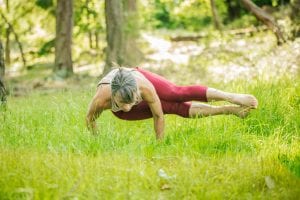
 Side Crow, or Parsva Bakasana, is a challenging arm balance that combines twisting, core control, shoulder stability, wrist loading and balance. It can be an exciting pose to work toward, but it is best approached through progressive preparation rather than by trying to “muscle” into the final shape.
This sequence combines core work, twists, standing poses and Side Crow progressions. It also includes optional breathwork inspired by Kundalini and pranayama traditions.
What Side Crow Can Help You Develop
Side Crow can challenge:
- core strength
- shoulder and arm strength
- wrist tolerance
- twisting control
- coordination
- balance
- body awareness
The pose also requires concentration, but I would avoid presenting it as a treatment for stress or anxiety.
Start With Core Work
Begin with a few movements that prepare the trunk.
You can try:
- bicycle crunches
- Boat Pose
- twisting Boat
- cross-legged lift or Lolasana preparation
- slow knee-to-chest work from Plank
Keep the movements controlled rather than rushing through them.
Warm Up the Wrists and Shoulders
Before arm balancing, spend a few minutes preparing the upper body.
Try:
- wrist circles
- rocking forward and back on hands and knees
- Cat-Cow
- Plank
- Downward-Facing Dog
- shoulder-blade protraction and retraction
If the wrists feel painful, reduce the load or skip the arm balance.
Chair Pose With a Twist
Come into Chair Pose.
Bring the hands to prayer and rotate gently toward one side.
Keep the knees comfortable and the spine long.
You can stay here as a complete variation without progressing to Side Crow.
Standing Twist Flow
Move through a sequence such as:
- Warrior II
- Side Angle
- Triangle
- Revolved Crescent Lunge
- Twisting Prayer Lunge
- Twisting Chair
This helps prepare the spine, hips and trunk for the rotation required in Side Crow.
Side Crow Preparation
From a squat or Twisting Chair, rotate the torso to one side.
Place both hands on the floor about shoulder-width apart.
Bring the outer thigh toward the upper arms.
Shift the chest forward gradually.
At first, keep both feet on the floor.
Lift One Foot
Once you feel stable, lift one foot at a time.
This helps you learn where your centre of mass needs to be without committing fully to the pose.
Keep the elbows bent and the shoulders active.
Side Crow
When ready, shift more weight forward and lift both feet.
Keep the legs together or explore a staggered position depending on the variation.
Hold briefly, then come down with control.
There is no need to hold for a long time.
Use Blocks if Needed
A block under the feet can raise the starting position.
A bolster or block placed in front of you can also reduce fear of tipping forward.
Props are useful tools, not shortcuts.
Progression Into More Advanced Variations
Once Side Crow feels stable, you can explore more challenging transitions such as:
- Side Crow to Eka Koundinyasana variation
- Side Crow from Twisting Chair
- standing twist to arm balance
- Side Crow from a low squat
Only add these if the wrists, shoulders and core feel ready.
Optional Breathwork: Kapalabhati or Breath of Fire
Kapalabhati and Breath of Fire are both more vigorous breathing practices, but they are not identical in every tradition.
Both involve faster breathing and should be approached carefully.
They are not necessary for Side Crow.
If you choose to use them, learn from an experienced teacher and stop if you feel dizzy, anxious, light-headed or uncomfortable.
People who are pregnant or who have cardiovascular, respiratory or other medical concerns should get professional guidance before practicing forceful breath techniques.
Keep Breathwork Claims Grounded
I would remove claims that rapid breathing:
- “cleanses toxins”
- increases cerebrospinal fluid circulation in a specific therapeutic way
- prevents colds
- treats respiratory conditions
- directly balances the nervous system
These are too strong for a general yoga article.
Kundalini-Inspired Mantra Practice
If mantra is part of your personal or teaching practice, you can include it as an optional spiritual element.
Ong Namo Guru Dev Namo is traditionally used in Kundalini Yoga at the beginning of practice.
It can be presented respectfully as a traditional chant associated with that lineage, rather than as a scientifically proven way to access universal wisdom or alter health.
Finish With Pigeon and Rest
After the stronger twisting and arm-balance work, slow the pace down.
Try:
- Pigeon or Figure Four
- Child’s Pose
- Supine Twist
- Supported Bridge
- Savasana
Let the wrists and shoulders fully unload.
Focus on Skill, Not Performance
Side Crow is not a measure of how advanced your yoga practice is.
The most useful parts are often the preparation: learning to twist with control, shift weight into the hands, engage the trunk and stay calm while trying something difficult.
If you want to explore arm balances and yoga strength in person, learn more about Yoga & Mobility Classes in Nanaimo.
You may also enjoy Crow Pose Progressions for Strength, Balance and Confidence and Bird of Paradise and Flying Split Yoga Sequence.