Yin-Yang Yoga Sequence: Balance, Breath and Grounding

Yin-Yang Yoga Sequence: Balance, Breath and Grounding
Beginner-friendly, beginner-friendly yoga class, beginner yoga class, yin-yang yoga class

This yoga lesson was originally created as the first class in a series of Yoga Teacher Training lesson plans. The idea was to begin simply, with breath, foundational poses and a balance between more active and more restful movement.

The sequence combines standing poses, a Classical Sun Salutation and slower floor work. It can be adapted for beginners or used as a framework for teachers creating their own classes.

Begin With the Breath

Start lying on your back in a comfortable constructive rest position, with the knees bent and feet on the floor.

Place one hand on the chest and one on the abdomen. Let the breath become slower and notice the lower ribs and belly gently expanding as you inhale.

You can silently repeat:

“I am breathing in.”
“I am breathing out.”

The goal is not to force a deep breath, but simply to notice it.

Child’s Pose

Move into Child’s Pose and allow the body to settle.

Use support under the head or hips if needed.

Take a few comfortable breaths and notice the contact between your body and the floor.

Anjali Mudra

Come to sitting or standing and bring the palms together at the heart.

Anjali Mudra is traditionally used as a gesture of greeting, respect or intention.

Rather than assigning one fixed meaning to it, you can use the gesture as a moment to pause and decide what you want to bring into your practice.

Mountain Pose

Stand in Tadasana, or Mountain Pose.

Feel the feet on the ground and allow the spine to lengthen naturally.

The goal is not rigid stillness. Let yourself make small adjustments as needed.

Use Mountain Pose to establish a stable starting point before beginning the more active part of the practice.

Classical Sun Salutation

Move through a simple Classical Sun Salutation.

You might include:

  • Mountain Pose
  • Forward Fold
  • Half Lift
  • Low Lunge
  • Plank
  • Cobra
  • Downward-Facing Dog
  • Low Lunge on the second side
  • Forward Fold
  • return to standing

Move slowly enough that you can continue breathing comfortably.

Repeat several times if it feels good.

Explore the Yang Side

The more active portion of the class can include standing movement, Plank and flowing transitions.

This is the “yang” side of the practice: effort, strength, heat and movement.

That does not mean pushing to exhaustion.

Try to find a level of effort that still allows you to breathe and stay aware of what you are doing.

Transition Into Slower Floor Work

Once the body is warm, gradually slow the pace.

This shift gives the practice a different quality: less movement, longer pauses and more attention to sensation.

Low Squat

Come into Malasana or a supported squat.

Use blocks, a wall or support under the heels if needed.

Stay for a few breaths without forcing the hips lower.

Bridge Pose

Lie on your back with the knees bent and feet on the floor.

Lift into Bridge Pose.

You can practice an active Bridge or place a block under the pelvis for a more supported variation.

Reclining Figure Four

Cross one ankle over the opposite thigh.

Stay here or draw the legs toward the chest.

Keep the stretch comfortable rather than pulling aggressively.

Repeat on the other side.

Reclining Spinal Twist

Bring both knees toward the chest and allow them to fall gently to one side.

Keep the twist easy enough that you can breathe comfortably.

Repeat on the other side.

Yin and Yang as a Practice Idea

In yoga, the language of yin and yang can be a useful metaphor for balancing different qualities.

A practice might include both:

  • effort and ease
  • movement and stillness
  • strength and softness
  • attention outward and attention inward

You do not need to achieve a perfect state of “balance.” The value is simply noticing what you may need more or less of on a particular day.

The Meaning of Om

Om is a traditional sacred sound used in several Indian spiritual traditions, including Hinduism and yoga.

It can be chanted at the beginning or end of practice as a way to bring the group together and create a moment of focused attention.

Traditional teachings give Om rich philosophical and spiritual meanings, but claims that the physical universe is literally made of a particular sound frequency should be understood as spiritual or metaphorical teachings rather than scientific fact.

If chanting is not meaningful to you, you can simply sit quietly or focus on the breath instead.

Closing With Namaste

Namaste is a traditional Sanskrit greeting commonly translated in a simple sense as an expression of respect or acknowledgement.

You may choose to close the practice with Namaste, another short phrase, or simply a moment of silence.

The important part is creating a clear ending to the practice rather than trying to assign one universal spiritual interpretation.

A Foundation for Future Yoga Practice

This first lesson is intentionally simple.

Breath, foundational poses, Sun Salutations and slower floor work create a base that can later support more challenging balances, transitions and sequences.

If you want to explore yoga and movement with me, learn more about Yoga & Mobility Classes in Nanaimo.

You may also enjoy Classical Sun Salutations and Yin-Inspired Yoga Sequence and Yoga Breathwork: Ujjayi, Nadi Shodhana & More.
Taking Steps Toward Better Physical and Mental Well-Being

Taking Steps Toward Better Physical and Mental Well-Being

Physical health, mental health, journaling, self-care, well-being, healthy habits

Physical and mental health are closely connected. How we move, sleep, eat, manage stress and care for ourselves can affect both how the body feels and how we function emotionally.

You do not need to overhaul your whole life at once. Small, consistent habits can often be more realistic and sustainable than trying to change everything at the same time.

Physical and Mental Health Are Connected

Stress, low mood, pain, poor sleep and fatigue can influence one another. For example, ongoing pain can affect mood and motivation, while stress can make sleep, digestion and muscle tension feel worse.

That does not mean every physical symptom is caused by stress or that exercise can replace mental-health care. It simply means that looking at well-being as a whole can be more useful than treating the body and mind as completely separate.

Build a Realistic Self-Care Routine

Self-care does not have to mean spa days or elaborate routines. It can include basic habits that help you function better.

That might mean:

  • moving your body regularly
  • eating enough nourishing food
  • getting outside
  • sleeping consistently
  • taking breaks
  • spending time with supportive people
  • asking for help when you need it

The most useful routine is one you can actually maintain.

Use Movement as Support, Not Punishment

Exercise can support physical health, energy, strength and mood, but it does not need to be extreme.

Walking, strength training, yoga, mobility work, dancing, hiking and group fitness can all be valuable. What matters most is finding forms of movement that suit your body and that you are willing to return to consistently.

If you want individualized support, you can learn more about Personal Training in Nanaimo or Group Fitness Classes in Nanaimo.

Make Space for Relaxation

Relaxation is not the same as eliminating all stress. Stress is part of life.

The goal is to have ways to come down from periods of high demand.

That might include:

  • walking outside
  • breathing exercises
  • yoga
  • stretching
  • listening to music
  • spending time away from screens
  • sitting quietly
  • being in nature

For some people, a few minutes is enough to create a useful reset.

You can also read Mindfulness: A Simple Practice for Stress, Awareness and Well-Being.

Protect Your Sleep

Sleep supports recovery, concentration, mood, immune function and physical performance.

Most adults benefit from roughly seven to nine hours of sleep, although individual needs vary.

Simple habits can help:

  • keeping a relatively consistent sleep and wake time
  • reducing bright screens close to bedtime
  • keeping the room dark and comfortable
  • limiting caffeine late in the day
  • creating a short wind-down routine

If sleep problems are persistent or severe, it is worth discussing them with a healthcare professional.

Try Journaling

Journaling can be useful for both practical planning and self-reflection.

You might use it to track workouts, goals, habits, energy or sleep. You can also write about thoughts, emotions, worries or things you are grateful for.

There is no correct format.

Sometimes simply writing down what is happening can make patterns easier to notice.

For help creating realistic goals, read Goal Setting for Health and Fitness.

Focus on Small Changes

Health does not require perfection.

You might start by choosing one thing:

  • walk for 15 minutes
  • drink water with lunch
  • go to bed 30 minutes earlier
  • prepare one meal ahead
  • take one yoga class
  • strength train twice this week
  • journal for five minutes

Once one habit feels manageable, you can build from there.

Know When You Need More Support

Exercise, sleep, mindfulness and healthy habits can support well-being, but they are not replacements for counselling or medical care when someone is struggling.

If stress, anxiety, low mood or emotional patterns are becoming difficult to manage alone, professional support can help.

For deeper emotional and mental-health support, you can explore Vancouver Island Holistic Counselling.

Build a Life That Supports You

Physical and mental well-being are not destinations you finally reach.

They are ongoing processes shaped by daily choices, relationships, circumstances and support.

The goal is not to do everything perfectly. It is to keep taking realistic steps toward feeling stronger, more supported and more connected to yourself.

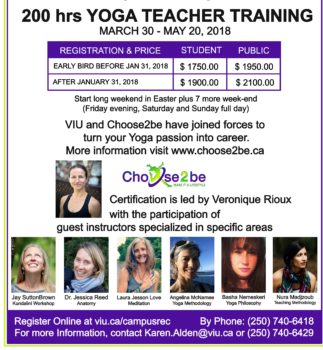
Choose2be Yoga School: Our First 200-Hour Yoga Teacher Training in 2018

Choose2be Yoga School: Our First 200-Hour Yoga Teacher Training in 2018


In spring 2018, Choose2be partnered with Vancouver Island University Campus Recreation to offer its first 200-hour Yoga Teacher Training in Nanaimo. This program brought together a diverse group of teachers with backgrounds in yoga, anatomy, meditation, communication, breathwork, philosophy and movement.

This page now serves as part of the history of Choose2be Yoga School. The dates and workshops below describe the 2018 training and are not a current course schedule.

“This is one of the best 200-hour teacher training programs I have seen! Such high-calibre teachers—so diverse, interesting and important material.”
— Lindsay J. Campa, Yoga Therapist

The Beginning of Choose2be Yoga Teacher Training

The 2018 program ran from March 30 to May 20 and included approximately 180 instructional hours plus 20 hours of homework and independent study.

My goal was to create more than a training focused only on learning yoga poses. I wanted students to deepen their own practice while developing the skills and confidence to guide other people.

The curriculum included yoga philosophy, anatomy, asana, pranayama, meditation, mantra, sequencing, teaching methodology and practice teaching. Guest instructors brought different areas of expertise so students could learn from several perspectives rather than only one teacher.

A Collaborative Approach to Teacher Training

One of my favourite parts of creating this program was bringing together teachers with very different backgrounds.

The 2018 faculty and guest workshops included areas such as:

  • anatomy and anatomical variation
  • yoga teaching methodology
  • Nonviolent Communication
  • meditation and restorative yoga
  • yoga philosophy
  • Kundalini yoga
  • breathwork
  • movement and dance
  • yoga therapy
  • sequencing, cueing and assisting

That collaborative model continues to influence the way I think about Yoga Teacher Training today.

Anatomy and Individual Bodies

Dr. Jessica Reed taught anatomy with a focus on bones, muscles and how anatomical differences can affect yoga postures.

One of the important ideas explored in the program was that bodies are not all built exactly the same. Yoga does not need to look identical from one person to another, and understanding anatomical variation can help teachers offer more appropriate options.

Teaching Methodology

Several instructors explored the art of teaching yoga, including how to sequence a class, communicate clearly, observe students and adapt movement.

Students also spent time practice teaching throughout the training.

Becoming a yoga teacher involves much more than memorizing poses. It requires learning how to create an experience, communicate safely and confidently, and respond to the people actually standing in front of you.

Communication and Relationships

The program included a workshop based on Nonviolent Communication, developed by Marshall Rosenberg.

Students explored listening, identifying feelings and needs, expressing themselves more clearly and approaching difficult conversations with greater empathy.

I valued including communication skills because teaching is fundamentally relational. Knowing yoga is one part of the job; knowing how to connect with people is another.

Meditation, Philosophy and Breath

The training also included meditation, yoga philosophy and several approaches to breath and awareness.

Different guest teachers introduced students to their own traditions and perspectives. As with any yoga training, students were encouraged to explore the practices, ask questions and develop their own understanding over time.

Breath remains an important part of my teaching today. You can read more in Ujjayi Breath: How to Use Yogic Breathing in Your Yoga Practice.

Movement Beyond Traditional Asana

The 2018 program also explored dance, creative movement, restorative practices and different approaches to embodied learning.

This was important to me then and has become even more important in my work over the years.

My teaching today draws from yoga, mobility, strength training, dance and functional movement. I increasingly see these as complementary tools rather than separate disciplines.

Yoga Therapy and Adaptation

Guest teachers also introduced students to therapeutic and individualized approaches to yoga.

An important lesson was that yoga teachers should understand the limits of their scope. Yoga can be adapted to many bodies and circumstances, but yoga teachers are not automatically healthcare professionals or yoga therapists.

Knowing when to modify, when to refer and when something is outside your training is part of responsible teaching.

The 2018 Graduates

The first Choose2be Yoga Teacher Training cohort holds a special place in the history of the school.

It was exciting to watch students move from their own personal practice into teaching, experimenting, asking questions and developing their own voices.

That first training also taught me a great deal about what I wanted future Choose2be programs to become.

The Next Chapter of Choose2be Yoga Teacher Training

I am now developing the next evolution of the Choose2be Yoga Teacher Training for 2027/2028.

The new program will build on what worked well in earlier trainings while reflecting more than two decades of my experience teaching fitness, yoga and movement.

The developing curriculum is expected to integrate yoga practice and philosophy with anatomy, mobility, functional movement, strength, breathwork, teaching methodology, personal development and plenty of practice teaching.

Rather than recreating the 2018 program exactly, I want the next training to reflect how my own teaching has evolved.

You can learn more about the developing Yoga Teacher Training in Nanaimo and read about my own Yoga Teacher Training journey.

Looking Back and Moving Forward

The first Choose2be Yoga Teacher Training was an ambitious collaborative project, and I remain grateful to the teachers and students who helped bring it to life.

The details on this page are part of that history.

The next chapter will be different, but the central intention remains the same: to help people deepen their practice, understand movement more fully and become thoughtful, confident teachers in their own way.

Kids Yoga Lesson Plan: Weather and Seasons

Kids Yoga Lesson Plan: Weather and Seasons

Weather-themed yoga, children’s health, yoga for kids, educational, weather sounds, human mandala

Weather and seasons make a great theme for kids yoga because they naturally invite movement, imagination and storytelling. Children can become trees, snowflakes, rainstorms, animals, wind and sunshine while learning to notice how nature changes throughout the year.

This lesson can be adapted for parents, teachers, yoga instructors or group leaders. It works especially well as a 45-minute parent-participation class, but you can shorten it for younger children.

Start With Simple Expectations

Begin with a short welcome circle and a few simple group expectations: keep hands to yourself, use kind words, take turns and have fun.

A quick name game or movement song can help everyone settle in before you begin.

Spring

Spring is a natural time to explore growth, energy and new beginnings.

Try movements such as:

  • Tree Pose — stand tall like a tree beginning to grow
  • Bird / Warrior III — stretch out like a bird flying
  • Gate Pose — open the side body like a garden gate
  • Planting Seeds — fold forward toward the ground
  • Planting a Garden — squat down and pretend to dig
  • Watering Can / Triangle Pose — tip gently to one side
  • Baby Bean Sprout / Boat Pose — grow upward from a tiny seed
  • Caterpillar / Locust Pose — wiggle along the ground
  • Bee — buzz around the garden

Keep the poses playful and let children invent their own spring movements too.

Summer

Summer can be more energetic and expansive.

Try:

  • Butterfly Pose
  • Picking Apples — reach high in different directions
  • Flower Pose
  • Wheelbarrow-inspired movement
  • Sun Stretch — reach arms overhead and open wide

You can also add swimming motions, beach movements or pretend to run through a sprinkler.

Autumn

Autumn is perfect for exploring changing leaves, animals and harvest time.

Try:

  • Crescent Moon
  • Tree Pose with falling leaves
  • Warrior III as birds flying south
  • Chair Pose as a farmer driving a tractor
  • Bear Walks
  • Child’s Pose as a hedgehog getting ready to rest
  • Fox Pose or kneeling moon gazing
  • Butterflies migrating
  • Squirrels collecting and hiding pretend food

Ask children what colours they see in fall and let them move like leaves blowing in the wind.

Winter

Winter gives you lots of opportunities for imaginative movement.

Pretend to put on warm clothes: long johns, snow pants, boots, mittens and hats.

Then try:

  • Penguin Walks
  • Snowy Tree Pose
  • Forward Fold to dig in the snow
  • Rock and Roll Snowballs
  • Star Pose as a Snowflake
  • Snow Angels
  • Tiger Balance moving very slowly
  • Big Group Snowflake

For the group snowflake, sit in a circle with feet toward the middle and create different shapes together. Keep enough space so children can move safely.

Weather Movement Game

Ask children:

What is your favourite kind of weather?

Then turn the answers into movement.

Wind

Make big arm circles, sways and gentle twists.

Pretend the wind is pushing you from side to side.

Thunder and Lightning

Reach arms overhead for lightning, then fold forward with a strong “boom” sound for thunder.

You can ask: Which comes first, lightning or thunder?

Rain

Create different rain sounds:

  • hard rain — clap thighs
  • soft rain — tap fingers together
  • mist — rub hands gently

Build the sound slowly, let the storm get louder, then gradually fade away.

Sunshine

Inhale and reach the arms up.

Exhale and lower them slowly, imagining warm sunlight all around you.

Rainbow

Use a big side bend or arch shape to become a rainbow.

You can also make a rainbow tunnel by having children stand in pairs, hold hands overhead and let others walk underneath.

Escape the Rainstorm

Move around the room as if a storm is coming.

Lift the knees high through imaginary tall grass, jump over puddles, crawl under pretend branches and pause in Tree Pose for shelter.

When the sun comes out, slow the movement down and return to the circle.

Human Mandala

Sit in a circle and move together.

You might try:

  • reach one arm up and bring it back to the heart
  • side stretch
  • gentle twist
  • shoulder rolls
  • fold forward
  • extend one leg and reach
  • wave the feet
  • move into Crab or Downward-Facing Dog

The goal is not perfect synchronization. It is simply moving together as a group.

Music and Sound

Weather and season songs can make transitions easier and keep children engaged.

Rather than depending on a fixed playlist, choose age-appropriate music about sunshine, rain, seasons or nature that suits your group. If you use recorded music in a public class, make sure your setting has appropriate music licensing.

Weather Relaxation

Finish with a short guided relaxation.

Invite children to lie down and imagine the weather becoming calm.

You might say:

“Imagine the wind slowing down, the rain becoming softer, and the clouds moving away. The sun comes out and everything becomes warm and quiet.”

Keep it brief and gentle.

Keep Kids Yoga Creative

Children do not need perfect poses. The real value is in movement, imagination, coordination, cooperation and play.

A weather and seasons theme gives you endless ways to explore movement while helping children connect with the natural world.

For more themed lessons, try Kids Yoga Lesson Plan: In the Garden, Kids Yoga Lesson Plan: Going Into Space or Kids Yoga Lesson Plan: Beach & Ocean Theme.

If you enjoy leading creative movement with children, you may also be interested in the Circus Arts Leader Certification.

Kids Yoga Lesson Plan: Going to the Beach and Ocean

Kids Yoga Lesson Plan: Going to the Beach and Ocean

Yoga beach theme, yoga ocean theme, kids lesson plan yoga, ocean poses yoga, ocean games yoga

A beach and ocean theme is a fun way to get children moving, imagining and learning at the same time. Kids yoga works especially well when poses are connected to stories, animals, games and music rather than taught as a series of formal postures.

This lesson can be adapted for parents, teachers, yoga instructors or group leaders. You can shorten it for younger children or expand it into a 45-minute class.

Start With Simple Group Expectations

Before beginning, keep the expectations short and positive. You might remind children to keep hands to themselves, take turns, use kind words and have fun.

A circle setup can work well because everyone can see one another and participate together.

Warm-Up

Start with simple movements to wake up the body:

  • shoulder rolls
  • gentle head turns
  • arm circles
  • standing side bends
  • easy twists
  • cat-cow or other spinal movements
  • marching or swaying to music

Keep the pace light and playful.

Pack for a Day at the Beach

Pretend you are getting ready for a beach adventure.

Have the children act out putting on bathing suits, sunglasses, hats, flip-flops and sunscreen. Pretend to pack towels, water, snacks, buckets, shovels and beach toys.

This gives you an easy transition from imagination into movement.

Ocean-Themed Yoga Poses

Use familiar shapes and give them playful ocean names.

  • Easy Pose — Looking at the Ocean: Sit comfortably and imagine watching the waves.
  • Mountain Pose — Beach Umbrella: Stand tall and reach your arms overhead.
  • Warrior III — Swimming: Balance on one leg and reach your arms forward like you are gliding through water.
  • Triangle Pose — Windsurfing: Open the body and imagine catching the wind.
  • Chair Pose — Beach Chair: Bend the knees and pretend you are sitting in the sand.
  • Forward Fold — Jellyfish: Let your arms hang and sway gently.
  • Downward-Facing Dog — Sandcastle: Make a strong triangle shape.
  • Cobra Pose — Harbor Seal: Lift the chest and make a playful seal sound.
  • Locust or Shark Pose — Shark: Lie on your belly and reach the arms back.
  • Child’s Pose — Sea Urchin: Curl into a small shape.
  • Boat Pose — Fishing Boat: Balance and rock gently if comfortable.
  • Tabletop Variation — Crab: Lift into a reverse tabletop and move like a crab.
  • Happy Baby — Sea Otter: Rock gently from side to side.
  • Wide-Leg Seated Stretch — Starfish: Reach in different directions like starfish arms.
  • Lying on the Back — Kelp Forest: Wave arms and legs slowly like kelp moving with the current.

For younger children, accuracy is less important than imagination and safe movement.

Shell Listening Activity

Pass around seashells and invite the children to hold them quietly and listen.

You can ask:

What sounds do you notice?

This becomes a simple mindfulness activity without needing a long meditation.

Ocean Games

Jump the Waves

Have children jump over imaginary waves while staying in their own space. You can also use a long piece of blue fabric while adults or older children gently move it like water.

Beach Ball Circle

Pass a beach ball around the circle using hands. You can later try passing it gently with the feet while lying down.

Surfing Flow

Move between Warrior II, Extended Side Angle and Peaceful Warrior while pretending to surf.

If a shark appears, everyone can come down into a belly pose such as Locust.

Partner Boats

Sit facing a partner, hold hands if appropriate and gently rock backward and forward like boats on the water.

Scuba Adventure

Pretend to put on wetsuits and scuba gear, then move around the room searching for imaginary treasures.

Children can swim, crab walk or crawl through the “ocean.” At the end, return to the circle and let everyone share what they discovered.

Create an Ocean Story

Invite the children to help build the story.

You could begin with:

“We arrived at the beach and suddenly we saw…”

Let each child add an animal, object or adventure, and turn their ideas into movements or yoga poses.

This keeps the lesson interactive and gives children some ownership over the class.

Ocean Relaxation

Finish with a short guided relaxation.

Invite everyone to lie comfortably and imagine resting on a warm beach. Ask them to listen to the imaginary waves coming in and going out.

You might say:

“Imagine the waves moving slowly toward the shore and then back out to sea. Feel your breath moving in and out in the same gentle way.”

Give the children a short period of quiet before slowly bringing them back to sitting.

Music Ideas

Music can add energy and imagination to a themed class. Songs about oceans, beaches, boats and sea animals can all work well.

Rather than relying on a fixed playlist, choose age-appropriate music that fits your group and setting. If you are teaching publicly, make sure the venue has appropriate music licensing.

Keep Kids Yoga Creative

Children do not need perfect poses. The goal is to help them move, imagine, cooperate and enjoy being in their bodies.

A themed class like this can combine yoga, storytelling, music, games and relaxation in a way that feels playful rather than formal.

For another themed lesson, try Kids Yoga Lesson Plan: Going Into Space.

If you enjoy leading creative movement with children, you may also be interested in the Circus Arts Leader Certification, which includes games, juggling, hula hooping, poi and group activities.